Robots can do anything these days—repeatedly punch you in the face and kill you on behalf of the Chinese Communist Party, for instance.
Alarming (or possibly just alarmist) new reports warn Western consumers that China’s rising industrial capacities in the field of manufacturing humanoid robots could be exploited by the nation’s leaders as a kind of electronic Trojan Horse, allowing them to murder their trusting purchasers.
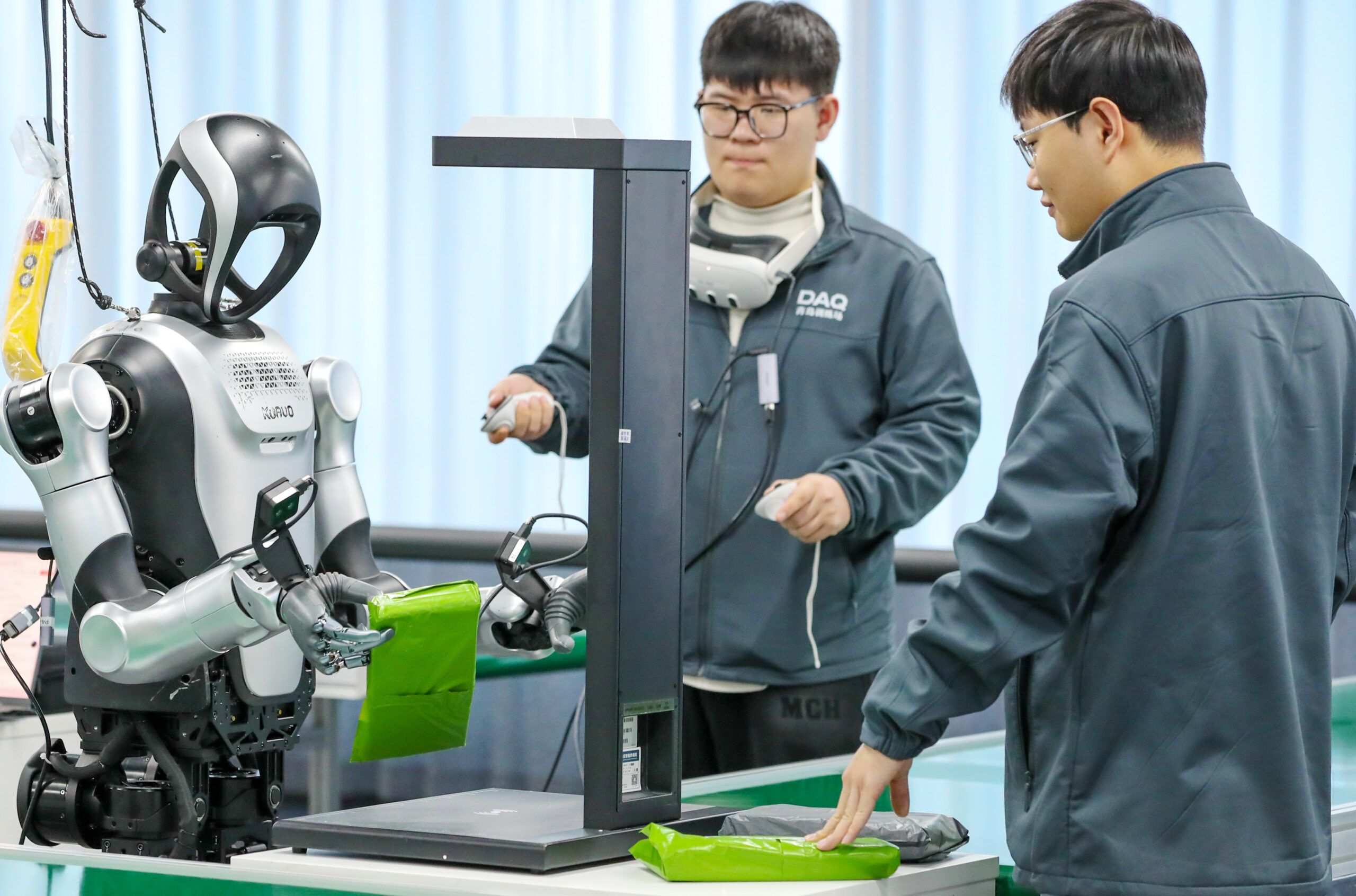
At a recent GEEKCon tech convention in Shanghai, the cyber-security research group DARKNAVY put a brand of Chinese-made androids designed to perform simple domestic chores like polishing your chopsticks on a shared stage with a mannequin, representing its hypothetical flesh-and-blood owner. They then hacked into it, causing the murder-droid to obediently swing its arms and punch the helpless dummy to the ground, Isaac Asimov’s first law of robotics be damned. The clever machine then used its onboard wireless communications facilities to infect fellow robots stationed nearby to begin abusing their own dummy-owners, too.
The suggestion was made that, should Beijing so desire, deliberate in-built security flaws in such contraptions could be exploited at the command of Chinese leader Xi Jinping to have us all murdered by cold metal hands in our beds, once the appliances become standard fixtures in Western households.
Robocriminals
Some have criticized such warnings as hysterical, but not as hysterical as a rival new report from the European Union-wide policing body Europol, which predicted that non-Robocop officers of the future will have to tackle angry, rioting mobs attacking androids for stealing their own rightful human jobs, leaving the meat-people unemployed and penniless.
Yet in revenge, Europol worried, the robots themselves may fight back. It therefore called for massive investment in an armory of “robo freezer guns” to be issued to European policemen today, before it is all too late.
This is honestly the kind of “threat” European police forces now want their citizens to be taxed into oblivion to pay for: anything, it seems, rather than address the true, current, likely mass-public-order threat to the continent represented by thousands upon thousands of violent, but wholly non-metallic (apart from all the nuts-and-bolts shrapnel fragments hidden inside their suicide-vests), imported Muslims. How about begging the taxpayer to invest in a few Nerf-modified sausage-guns instead, or perhaps even salami bazookas, to deal with the larger neo-Ottoman offenders?
Europol added that, in Europe’s nightmare new future, super-intelligent robots could turn to crime, committing acts of terrorism and grooming children. At around the same time as Europol was predicting robo-geddon, meanwhile, another disturbing new report claimed to provide figures showing that AI was already linked to 50,000 global job losses in 2025; I don’t expect murderers, jihadis, and pedophiles to be amongst the automated careers.
Terminators of Jobs
Sensationalist prognostications like Europol’s may seem improbable, but mass robot-caused job losses across coming decades are in fact deemed by many non-mad futurologists to be a likely phenomenon. Indeed, in some advanced corners of the globe, they are already here.
In 2015, a new guesthouse opened in the Japanese city of Nagasaki, given the strikingly honest name of “Strange Hotel.” Inside, the staff mostly consisted either of humanoid, Asian-looking robots, or of some special ones dressed like dinosaurs wearing small hats, which would check you in and out, clean your suite, and manage the cloakroom. Inexplicably, bedrooms come further equipped with a special concierge robot shaped like a female dwarf with a tulip for a head, complete with a smiley face drawn on it, who will do whatever you demand of it, no questions asked.
If a stressed Japanese salaryman should ask for a girl to be sent up to his room, one day soon he might even be delivered one of the growing number of rubbery, dead-eyed sex-bots to service his needs, meaning that quite shortly androids could even pose a threat to certain rubbery, dead-eyed, but non-robotic inhuman members of the oldest profession. Long the preserve of adult-rated sci-fi movies, sex-bots are now real; some come with interchangeable heads and bodies, so if you’ve ever fantasized about enjoying congress with the face of Scarlett Johansson mounted atop the body of Oprah Winfrey, now’s your chance. Many also have removable mix-and-match genitalia, just like Jean-Michel Trogneux.
Another fine old profession at risk might be that of bricklaying. U.S. company Construction Robotics has managed to produce a disappointingly non-humanoid robot bricklayer (it’s basically a robotic arm fed by a conveyor belt) capable of accurately laying 3,000 bricks per day, as opposed to 500 by the arm of a mere hairless apeling. Some human employees are still needed to supervise and program SAM, the Semi-Automated Mason, which began with a prohibitive rental-rate of $21,000 per month. But as costs of manufacture come down, mass layoffs are expected across the industry.
Farmers, train-drivers, even surgeons are all now finding that robots can perform certain aspects of their duties to an even higher standard than they can. In fact, this very column was written for me this week entirely by a particularly clever scientific calculator. I kid, of course, but how many columnists these days are surreptitiously employing the plagiarism services of ChatGPT and its ilk?
Responding to such reports, in 2017 the International Bar Association suggested that in future companies should have state-enforced quotas for human employees, and that all consequent human-made products on shelves should sport a sticker telling shoppers that they were shaped by pudgy little human hands, in the same way you have “Made in China” labels plastered on certain items today—like deadly killer robots, for example.
Tax On Tin
In May 2017, readers’ data-banks may surely recall, the French presidential election was won by a particularly plastic-looking post-human android named Emmanuel Macron. He must be especially thankful that one of his rivals, Benoit Hamon, of the French Socialist Party, did not win the voters’ approval, because if Hamon had become president then Monsieur Macron, as an obvious inhuman robot, would have been facing a rather large hike in his own personal tax bill. This was because Hamon’s genuine proposal for solving the possible future problem of mass machine-stoked unemployment was to start charging the robot job-thieves tax!
Hamon is not the only person to have suggested treating R2-D2 as a mobile piggy-bank. Bill Gates, the sinister silicon-brained mastermind behind Microsoft Windows, has had this to say on the matter:
The human worker who does, say, $50,000 of work in a factory, that income is taxed and you get income tax, social security tax, all those things; if a robot comes in to do the same thing, you’d think we’d tax the robot at a similar level.
Alternatively, as one of the very richest (approximate) humans in the world, maybe we could just tax the likes of Mr. Gates a bit more?
That was actually part of Hamon’s plan, as he wished to charge all businessmen a tax on the value of every asset they owned, from shares to buildings to machinery, each and every year. In fact, this charge was key to Hamon’s plans.
The initial problem of taxing robots would appear to be that robots don’t have any money. Therefore, when you examine Hamon’s proposals more closely, you will see that it is the robots’ corporate owners he actually wanted to tax, thus making the idea somewhat less insane than it initially appeared. It was the second part of Hamon’s plan which was actually mad.
Wages of Tin
Anticipating a future of never-ending joblessness, Hamon proposed robots’ owners be charged so much tax they would end up funding a free monthly wage of €750 a month for every French adult so they could lie around eating cheese all day long, watching a new robotic slave-class sweat oil for their own lazy French benefit. That’s €9,000 a year, for everyone, even the rich, because to cut down on admin costs (even government data-bots would be taxed, I suppose), it wouldn’t even be means-tested.
Considering how the robot tax would cost employers an estimated €400 billion per annum, however, Hamon doesn’t appear to have realized that this could well make it uneconomic for businessmen to employ robots in the first place, or at least to employ robots in France; businesses shifting not only human jobs abroad, but also metal ones, would be a disaster for everyone.
Furthermore, the €750 “citizens’ wage,” as such things are called, would not be issued in addition to current benefits payments but instead of them, at a single flat-rate, meaning that, for example, Bill Gates would get precisely as much support from the state as a blind one-armed dwarf in a wheelchair, should able-bodied Bill ever choose to set up residence in Paris. The whole scheme would cost €504 billion per year, over twice the level of French state spending at the time of Hamon’s election campaign, and utterly bankrupt the country.
“This is about looking into the future,” said Mr. Hamon, adding that his critics “could call it utopian if they want, but I am just anticipating the coming reality.” The actual coming reality, of course, was that Mr. Hamon gained a modern low of 6 percent of the vote, all but destroying the French Socialist Party in the process, with the human beings who still made up the majority of the Gallic electorate clearly thinking him a tin-pot tin-brain.
Voting Machines
Further proof that today’s Western politicians really are quite robotic has just come from the UK, where Conservative Party MPs are using AI clones of their Labour Party opponents to test out questions before quizzing their biological originals for real in the House of Commons.
Subscribe Today
Get daily emails in your inbox
A computing firm, Nostrada AI, has created digital AI “clone” versions of all 650 British MPs, by feeding their previous speeches and comments into a large databank. The robot versions of Labour Ministers are programmed to tap into this database and respond to queries in the same syntax, tone of voice, and outright lies habitually made use of by the true MPs. How can you tell the difference, one may ask?
“Labour Ministers are so predictably wooden and stuck in their failing ways that even AI can predict what they will say,” joked one Conservative Party MP. If this is true, it actually represents a potential national security risk. Foreign leaders have recently used clones of Labour Prime Minister Keir Starmer to predict how the man himself would act and react during EU negotiations and peace talks with Russia. (Why does it need a computer to predict the two simple words, “We surrender”?)
On reflection, therefore, maybe it would be better if certain human jobs were indeed ceded to the robots, at least in the field of contemporary politics. Who would you rather be governed by—Benoit Hamon, Emmanuel Macron, Keir Starmer, or a glorified mains-connected sandwich toaster? I choose the sandwich toaster. At least you can turn the bastard off.