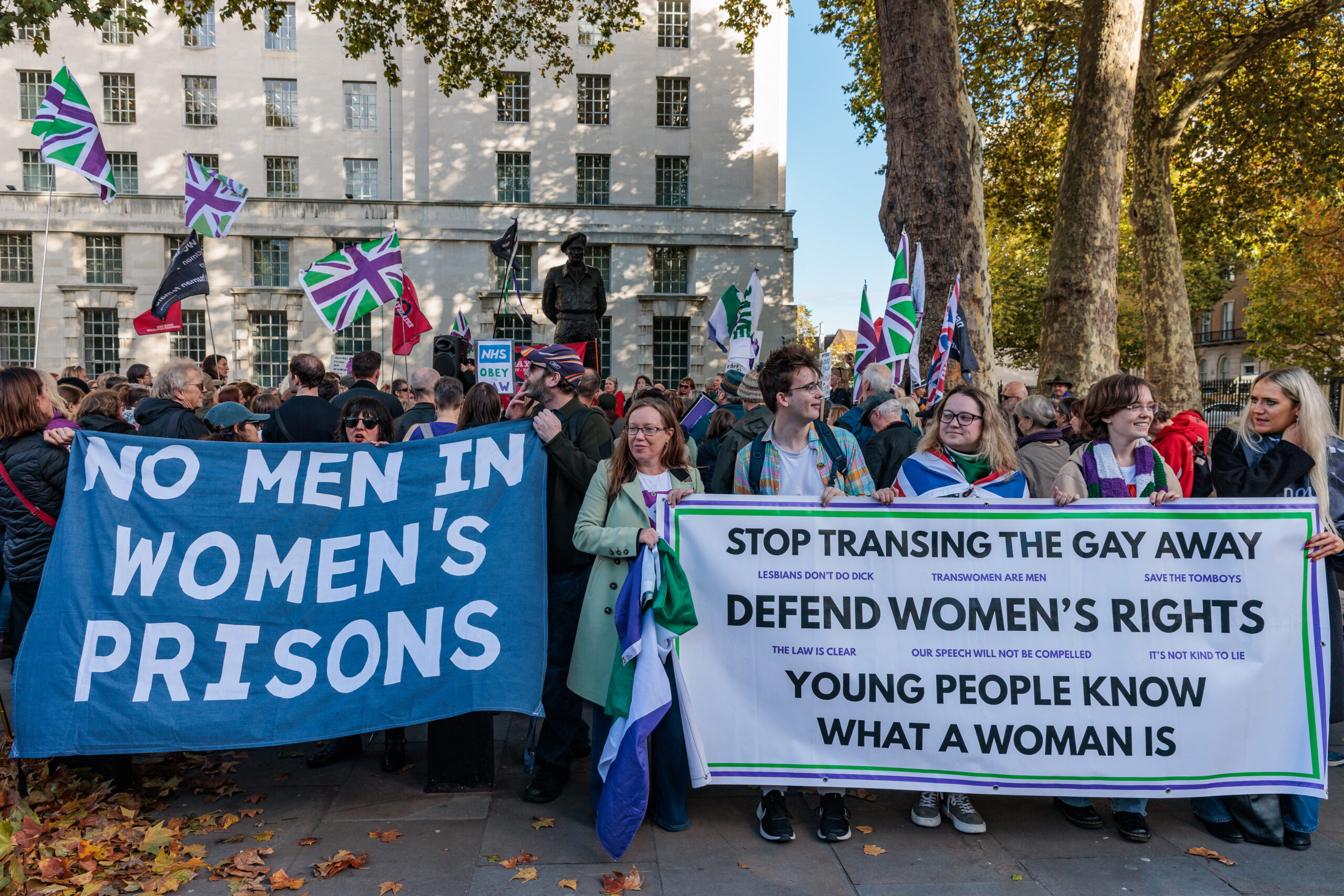
Late on Christmas Eve 2023, a 50-year-old nurse, Sandie Peggie, had an altercation in the women’s changing rooms of Victoria Hospital Fife with a transgender doctor, Beth Upton. She was dealing with a heavy period and objected to undressing before a male-bodied trans woman. She said he had no right to be there. The doctor reported Peggie for a transphobic “hate incident,” and this led to her being suspended from her job by NHS Fife.
Peggie fought against her suspension and took NHS Fife to an employment tribunal, claiming victimization and discrimination under the UK Equality Act 2010. The issue became a cause célèbre in the raging culture war in Britain between those who believe the doctrine according to Stonewall—that trans women are women—and so-called “gender-critical” feminists who believe that sex is innate, binary, and that trans women are, essentially, men.
This week, after two years of intense debate and public demonstrations, the tribunal finally reported that Peggie had indeed been “harassed” by the hospital authorities. Compensation will follow. This has been interpreted by her sympathizers, and by many in the UK media, as a victory for sex-based rights.
But it was one step forward, two steps back for Peggie and believers in biological essentialism.
The judge ruled that the Fife Health Board had acted unreasonably in the manner in which it suspended Peggie for misconduct simply on the basis of Upton’s claims. It delayed, obfuscated, and was wrong to tell Peggie not to discuss the case. However, the tribunal rejected Peggie’s claim that she had been discriminated against and victimized, either by NHS Fife or by the transgender doctor. The judge, Alexander Kemp, appeared to rule that Upton had a right to use a women’s changing room because, well, he looked a bit like a woman.
Now, the Supreme Court of the United Kingdom ruled in a landmark case earlier this year that, for the purposes of equalities law, “sex” means biological sex. The assumption of everyone, therefore, including the Equality and Human Rights Commission in its guidance to public bodies, is that single-sex spaces, like toilets and changing rooms, should be confined to biological females—to women—not just men wearing a skirt and make-up. The EHRC is about to issue updated guidelines to this effect.
But the Employment Tribunal judge appeared to disagree with the UK Supreme Court. Kemp said in his judgement that it had “not been unlawful” for Upton to use the female changing room at Victoria Hospital—at least before Peggie complained about it. This was, the judgement said, because he had “feminine clothes, hairstyle and voice… consistent with what is generally regarded as feminine in style.”
This has infuriated many women who regard these as outdated and superficial stereotypes of womanhood and think it is offensive to define sex in terms of appearance and style of dress. They also took exception to Judge Kemp’s reference to sex being “assigned at birth,” rather than observed. This encapsulates the Stonewall doctrine that sex is not binary but mutable, and that some people are born in the “wrong” bodies. Hence the slogan “trans women are women.”
Even more contentious, Kemp concluded there was “very far from sufficient reliable evidence” to conclude that a trans woman poses a “greater risk” to women in female changing rooms than another woman. This is disputed, to say the least. There is apparently incontrovertible evidence, throughout history, that men are more likely to harm women than other women are.
The judge had clearly imbibed large quantities of transgender Kool-Aid, for this is another argument put forth by Stonewall and other transgender activist groups, as well as by the former First Minister of Scotland Nicola Sturgeon. She always claimed that transgender people pose no threat to women—even though there was clear evidence that transgender sex offenders in Scotland had been changing their “lived gender” to gain access to women’s prisons.
In his ruling, Kemp also censured Peggie for robustly expressing her gender-critical beliefs and even claimed that some of her comments amounted to “harassment” of Upton and could have constituted a “hate incident”. She had, in conversations with colleagues, called him a “weirdo” and “a man in a dress”. The judge said that this could be seen as “transphobic”—which is actually a hate crime in Scottish law.
The tribunal report, while technically a victory for Peggie, actually amounted to a character assassination. The tribunal also heard that Peggie had made offensive remarks and jokes about Muslims. In conversations with colleagues she had said she was worried about the building of a mosque in Kirkcaldy and feared the introduction of Sharia law. She was alleged to have said she had “a good mind to post bacon through their letterbox.” These had nothing to do with her relations with Upton, but were used by the Fife Health Board to demonstrate her allegedly bigoted character.
This entire case appears to have been a classic example, in microcosm, of the cultural clash which has been disfiguring public-sector bureaucracies and much of corporate Britain for the last decade. On the one hand, fully paid-up members of the lanyard class of credentialed elites who obsess about politically correct speech and believe that trans women are essentially female; on the other, a working-class woman unversed in the correct language to use about race and gender, who calls a spade a spade and will not submit to the biological absurdity that people can change sex. The Supreme Court of the UK was on Peggie’s side, but this didn’t appear to matter to the tribunal.
Throughout over a year of hearings, a succession of health-service bureaucrats and equalities officers, invariably themselves female, gave evidence promoting the doctrine according to Stonewall. Isla Bumba, the Equality and Human Rights Lead for NHS Fife, told the tribunal in July that she “didn’t know” her own sex because “no one knows what their chromosomes are”. This is classic gender sophistry. It is not necessary to investigate chromosomes to determine sex, as any gynecologist would agree—it would make their job impossible were it so.
The HR department of Fife Health Board had been captured by transgender ideology in much the same way as the Scottish Government itself, which had, at the same time as Peggie’s complaint in 2023, become mired in controversy over allowing a double rapist, Isla Bryson, to be placed on remand in Cornton Vale women’s prison because he had self-identified as female after being charged with his offense. Other male-bodied sex offenders had also been placed in women’s prisons following guidance from the Scottish Government affirming that trans women should have their social gender recognized rather than their biological sex.
Kemp had clearly been influenced by the evidence from Bumba and other HR officials. He had “educated himself,” as progressives call it, and was fully versed in the metaphysics of non-binary gender ideology. Hence the suggestions that people are not born with a sex but have one “assigned” to them, presumably by transphobic midwives.
Kemp’s ruling held that “gender reassignment” was a protected characteristic under the Equality Act 2010 and that trans women therefore had equal rights to those of biological women when it came to using women’s facilities. He ruled that the legal definition of “sex” as biological sex does not automatically prohibit a trans woman from using a female changing room.
This is in direct conflict with the ruling by the UK Supreme Court in April 2025 in For Women Scotland v. The Scottish Ministers. This case had arisen initially because the Scottish government in 2018 started appointing trans women to public bodies and counting them as women for the purpose of meeting gender-equality quotas. “Real” women in the campaign organization For Women Scotland claimed that this erasure of women was contrary to equality law. The Supreme Court looked at all the arguments and decided that sex must mean biological sex, as recorded at birth, even if the trans woman possesses a Gender Recognition Certificate that says they are female.
Under UK law, transgender people are allowed to change their legal sex under the Gender Recognition Act, passed by the Labour government in 2004. Under this statute, a trans person can apply for a Gender Recognition Certificate confirming the change of legal sex provided he or she has had a medical diagnosis of gender dysphoria and has lived in their acquired gender for two years. A GRC allows them to change their birth certificate from male to female or vice versa. This law has never been repealed.
Subscribe Today
Get daily emails in your inbox
There has therefore been some confusion as to whether the GRC allows people with male bodies the right to access women’s single-sex spaces. Yet the confusion is not as significant as may appear. The 2010 Equality Act specifically permits that trans women be excluded from a women’s group “as a proportionate means of achieving a legitimate aim.” A group supporting female victims of sexual violence would be justified in excluding male-bodied trans women. This immediately imported biological sex into equality law as early as 2010.
At any rate, the Supreme Court decided that this 20-year-long confusion had to end, hence its affirmation of the common-sense view that sex is binary, immutable, and observed at birth. But transgender dogma is one of what are sometimes called the “luxury beliefs” of the educated classes. It is a kind of intellectual vanity which differentiates the bien-pensants elites from the uneducated lower orders with their supposedly bigoted attitudes.
The battle over biological sex is largely over, thanks to the Supreme Court, but as the Peggie case confirms, the culture war is still raging in the UK. Various women’s sex-based rights groups are already preparing appeals against the ruling of the Employment Tribunal. We may be hearing again from the Supreme Court before this war is over.