
The Savage Within
Modernity has inured us to danger, but it has not abolished it.
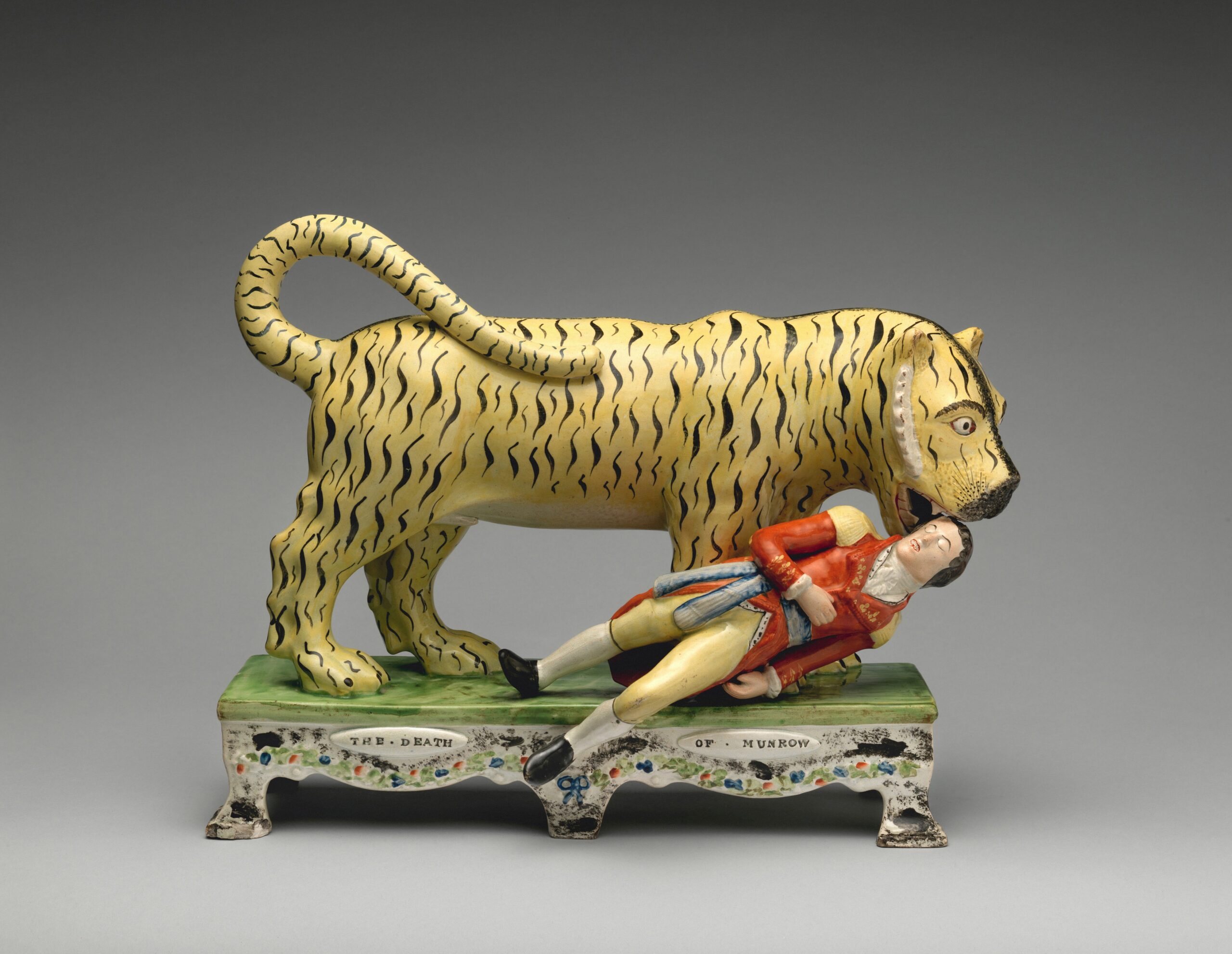
In England, a young man (lately identified as one William Chapman) was recently mauled to death by a Siberian tiger—a species not, I need hardly add, native to the country.
The tiger did not come to him; he went to the tiger. It was in a zoo, and Chapman insisted on jumping into the tiger’s compound. A woman tried to restrain him, but he overcame her resistance. According to reports, once in the compound he fell to his knees and appeared to pray (as well he might). The tiger took no notice of his prayers and made short work of him.
Was he suicidal? Was he a Nature mystic, trying to prove that Nature was fundamentally beneficent, if only one has the right feelings toward it? Was he trying to convert the tiger to whatever God he was praying to? As yet, we do not know and perhaps will never know.
If Chapman was of the Nature mystic school, he was not the first to find out the hard way that some creatures do not reciprocate benevolent human feelings toward them. I once read with amazement that a man went to live with grizzly bears in the wild, apparently in the belief that they would get used to him and even come to like or befriend him. He ended up as their dinner.
A lady in the United States kept many snakes of the large, constricting variety, but snakes do not become affectionate even to those who feed them; unlike dogs, they do not know on what side their bread is buttered, and she ended by being strangled by one of her pets. Naughty, naughty snake! Ungrateful serpent, reptilian reptile!
A slightly different story is that of John Allen Chau, an American missionary who went, illegally, to North Sentinel Island, an island in India’s Andaman archipelago. The Sentinelese are what would once have been called a primitive tribe. They are Stone Age people who are known to be hostile to any intrusion by outsiders, a hostility that they rarely have to put into effect because the Indian government has kept them completely isolated from the rest of the world. There are only about 150 of them.
Chau, however, was determined to convert them to evangelical Christianity, and paid some boatmen to drop him off on the island. Reader, they killed him—all too predictably.
Assuming that the man who jumped into the tiger pit was actuated either by Nature mysticism or religious enthusiasm, and not because he was suicidal (on one report, he made a gesture appealing for help as he was mauled), what unites these cases is sentimentality.
The actors in these dramas believed that reality could be molded by their goodwill: that as love makes the world go round, so goodwill turns the tiger vegetarian, the grizzly bear cuddly, the boa constrictor grateful, and an isolated Stone Age people (whose language, incidentally, remains completely unknown) ready for dialogue and thirsting for religious enlightenment. These people projected the goodness of their heart onto the world of tigers, bears, snakes and what used to be called savages—though the history of the 20th century has rendered us loath to use the word. If that century taught us anything, it was that the kingdom of the Savage is within us.
Now it does not follow from the fact that goodwill cannot do everything for you, that it can do nothing. On the whole, goodwill is to be preferred to ill will. But there are limits to what the former can achieve. The lion may sometimes lie down with the lamb, but it is best not to depend upon it.
A kind of goodwill, both saccharine and oleaginous, pervades a great deal of modern thought (or is it feeling rather than thought?). For example, I recently read a book by Hilary Cremin, the head of the Faculty of Education at Cambridge University, titled Rewilding Education, published this year. Cremin it was who so unctuously welcomed Jason Arday to her faculty for a position for which he was patently unsuited and unqualified, revelation of which fact led to his death once it was so cruelly (though rightly and justifiably) exposed in the press.
In her book, Cremin extols free-floating and objectless unconditional love as an attitude one should instill into children. It is obvious, of course, that love of everything is love of nothing; but even if it were possible to love everything, it would not be desirable to do so—for it would mean loving what is evil, and even rap music.
Subscribe Today
Get daily emails in your inbox
She believes that all living creatures have equal rights, so that, presumably, there is nothing to choose between a man and Plasmodium falciparum, and it would be the purest speciesism to attach more importance to the man’s life than to that of the plasmodia that are killing him. On this view, all predators are guilty of abuse of animal rights, and even plants—the Venus flytrap, for example—can be guilty of violating the rights of the fly (to life, liberty and the pursuit of happiness). Am not I a fly like thee, asked William Blake, but he didn’t mean it literally, unlike the head of the School of Education at Cambridge University.
Perhaps the population of rich countries has faced too little danger to resist indulging in the type of sentimentality outlined above. We have forgotten what was obvious until well into the 20th century: namely, that our lives hang by a thread. Thus we find it difficult to believe that danger could be real. At the same time, we seek out danger, because it excites us and relieves us of monotony. But we want, and expect, there to be an ambulance waiting to save us if the danger turns out to be nasty or more than we bargained for; if, that is, the danger is really dangerous.
In the case of the man who jumped into the tiger pen, ambulances (or rather, helicopters) did arrive, but too late to save him. The tiger, by the way, lives to maul another day. After all, it is not really his fault if he is a tiger.