The Nowak Murder Makes British Police Dysfunction Impossible to Ignore
Two-tier justice is being tested to the breaking point.
Britain’s public institutions are in a crisis of legitimacy. As British voters wonder why their taxes increase and their living standards stagnate, the state seems uninterested in improving the quality of their lives.
The Government, led by Sir Keir Starmer, has long since stopped functioning. After failing to implement some modest reforms to the welfare state a year ago, it has simply run out of authority and momentum. Today, the prime minister may well be replaced by a rival Labour Party politician, Andy Burnham, later this summer.
Since the 2024 General Election, there have been two consecutive summers of protests and demonstrations against mass immigration and the imposition of illegal immigrants on Britain’s population. Reform UK has won English local elections both this year and last year, cementing its place as the country’s most popular party. The British people are frustrated with a government that is set on taxing the working population to pay for welfare benefits and accommodating asylum-seekers in neighborhoods around the country.
This is the essential context in which the murder of Henry Nowak by Vickram Digwa took place. This murder, captured in its horror on Hampshire Police’s bodycam footage, has thrown into relief the callous reality of “two-tier” policing in modern Britain, which has been a Reform UK complaint since summer 2024. Digwa murdered Nowak in the streets one evening in Southampton in December 2025, and the trial has just concluded.
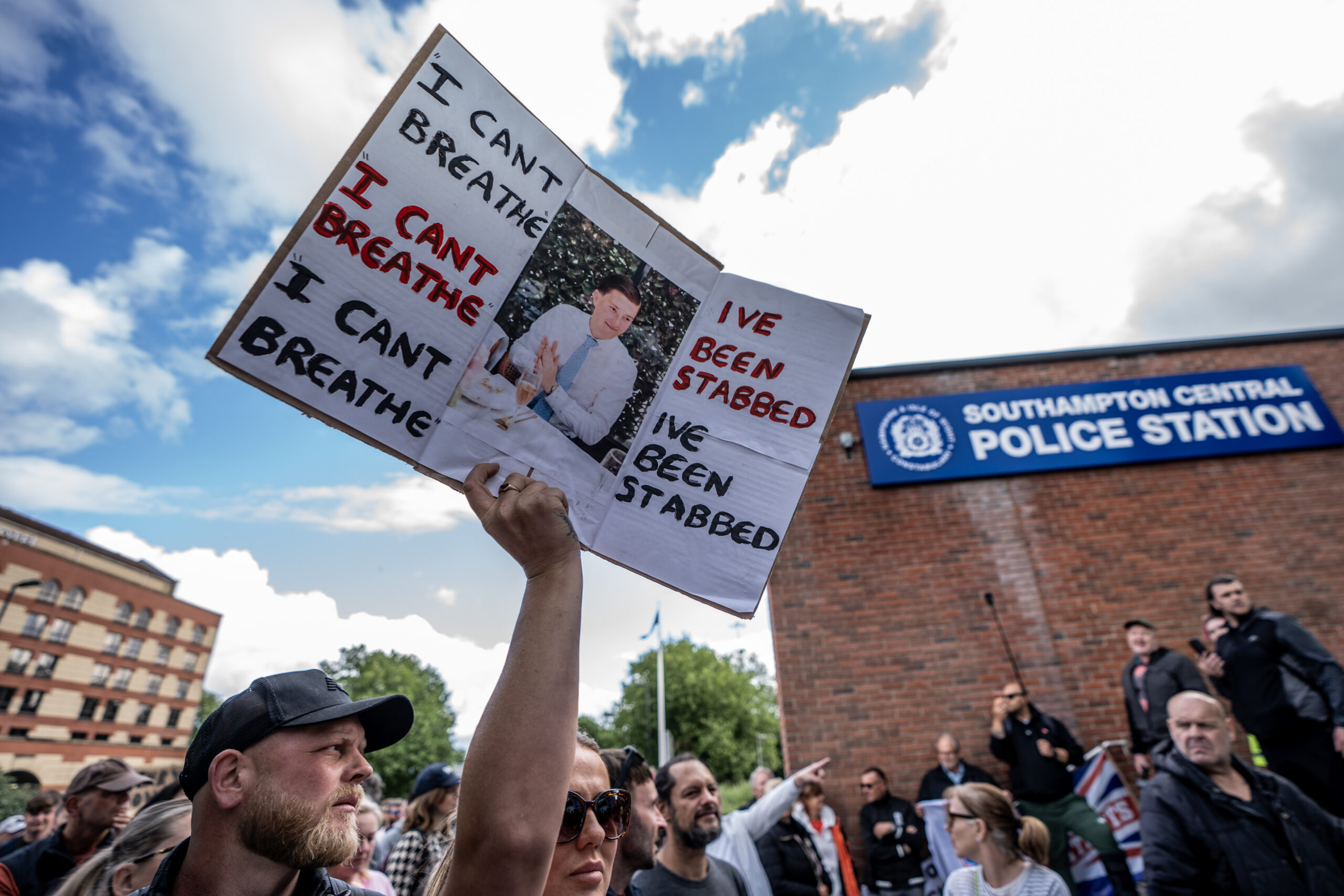
In the footage—released after public and political pressure—a dying Henry Nowak is seen telling police officers that he had been stabbed. One of the officers attending the scene coldly responds, “I don’t think you have, mate.” The following scenes are shocking, as the viewer then realizes that the police are in the process of arresting and handcuffing the dying Nowak, who is at this point losing consciousness and drowning in his own blood after having been stabbed in the chest by Digwa, who is still at the scene. The police were in fact there to arrest Nowak, as Digwa had claimed that he had committed a racist assault against him. Nowak is handcuffed and dragged across a gravel driveway to be searched, while Digwa and his brother can be heard repeatedly accusing him of racism. Only after he has lost consciousness do the officers realize the mistake they had made. Nowak’s last words were, “I can’t breathe.”
Digwa, a Sikh, murdered Nowak with an 8-inch long knife which he carried, claiming a special religious exemption offered to Sikhs which has allowed them to carry ceremonial knives openly in Britain for many years. This is a feature of Britain’s especially tolerant attitude to minority religions. While many Sikh men carry their religious knives—known as kirpans—in the form of golden pendants on necklaces or brooches in their turbans, some have taken to carrying longer, more threatening knives which they claim are inherited from specific, martial sects of Sikhism. Digwa was one of the latter, and it has been reported that he had been obsessed with knives and weaponry for some time.
The religious and racial nature of this crime is of tragic importance. Digwa stabbed Nowak to death in a seemingly random attack after he felt provoked by Nowak, who brushed past him at night. While Nowak was trying to escape, Digwa used the trump card to neutralize the situation: make an accusation of racism. Nowak, who had collapsed on the floor by the time the police arrived, was treated not with a presumption of innocence, but of guilt. The officers arrived on scene ready to investigate and prosecute a hate crime—a supposed racist assault committed by a white man, though there was no evidence of any injuries on Digwa—instead of the murder of a young British student by a legally sanctioned religious weapon.
Unsurprisingly, this has provoked a furious reaction. While Digwa has been given a life sentence for murder—with a minimum term of 21 years—the case has exposed the rotten attitude that has taken over the police and Britain’s public institutions regarding multiculturalism, race, and religion. Nowak’s grieving father criticized the police with dignity and gravity outside the courtroom after the trial finished. Britain’s police forces in the 2020s are avowedly “anti-racist” institutions, all bound by the Equality Act, and all publishing “race action plans” that dictate their approach to policing ethnic minorities.
Hampshire Police Force—in whose custody Nowak died—has its own plan, which explicitly references the murder of George Floyd in the USA as a reason for the necessity of implementing progressive policies in its own jurisdiction. These include being actively antiracist, addressing the history and trauma of how ethnic minorities have been policed in the past—examples of which are not provided, for either Hampshire or the United Kingdom—and establishing a devoted “Black and Ethic Minority network” to scrutinize the chief constable’s progress on delivering its anti-racism plan.
When Digwa made a false, malicious accusation of racism against Nowak, he was making an accusation of a crime that the modern-day British police are enthusiastic to prosecute, that indeed they are obliged to prioritize. When Digwa was sentenced, his own family disrupted proceedings in court, accusing the judge of racism, even after an irrefutable verdict was handed down by a jury. Digwa’s own family members, including his mother and brother, are being investigated for their complicity in Nowak’s murder.
Subscribe Today
Get daily emails in your inbox
While the police did secure a conviction and the court did its job, the way in which Nowak died in December 2025 leaves an indelible stain on British policing. Antiracism has been orthodoxy in the British police since the late 1990s, after the New Labour government’s Macpherson Report branded the police “institutionally racist.” This followed the Metropolitan Police’s incompetent investigation into the murder of black teenager Stephen Lawrence by a white gang in 1993. The findings of that report have been held over the police ever since, and decades of institutional change have turned Britain’s police into an arm of the progressive establishment rather than the impartial guarantor of law and order.
The British police today are rather a uniformed civil service, known for their enthusiastic policing of speech offences, the sinister creation of “non-crime hate incidents,” and an impassive attitude to crimes like theft and burglary, for which, instead of bringing a thief to justice, they palm victims off with official “crime numbers” so they can make insurance claims.
At the time of writing [late Tuesday night], a demonstration has been taking place outside Southampton’s central police station. Footage has been shared online of protesters waving “save our kids” placards, Union Jacks, and St. George’s Crosses throwing bricks, bottles and wheelie-bins at lines of riot police. A third summer of violence might be arriving on Britain’s streets, and the thin blue line gets thinner and more unpopular by the day.