Saving Camp of the Saints
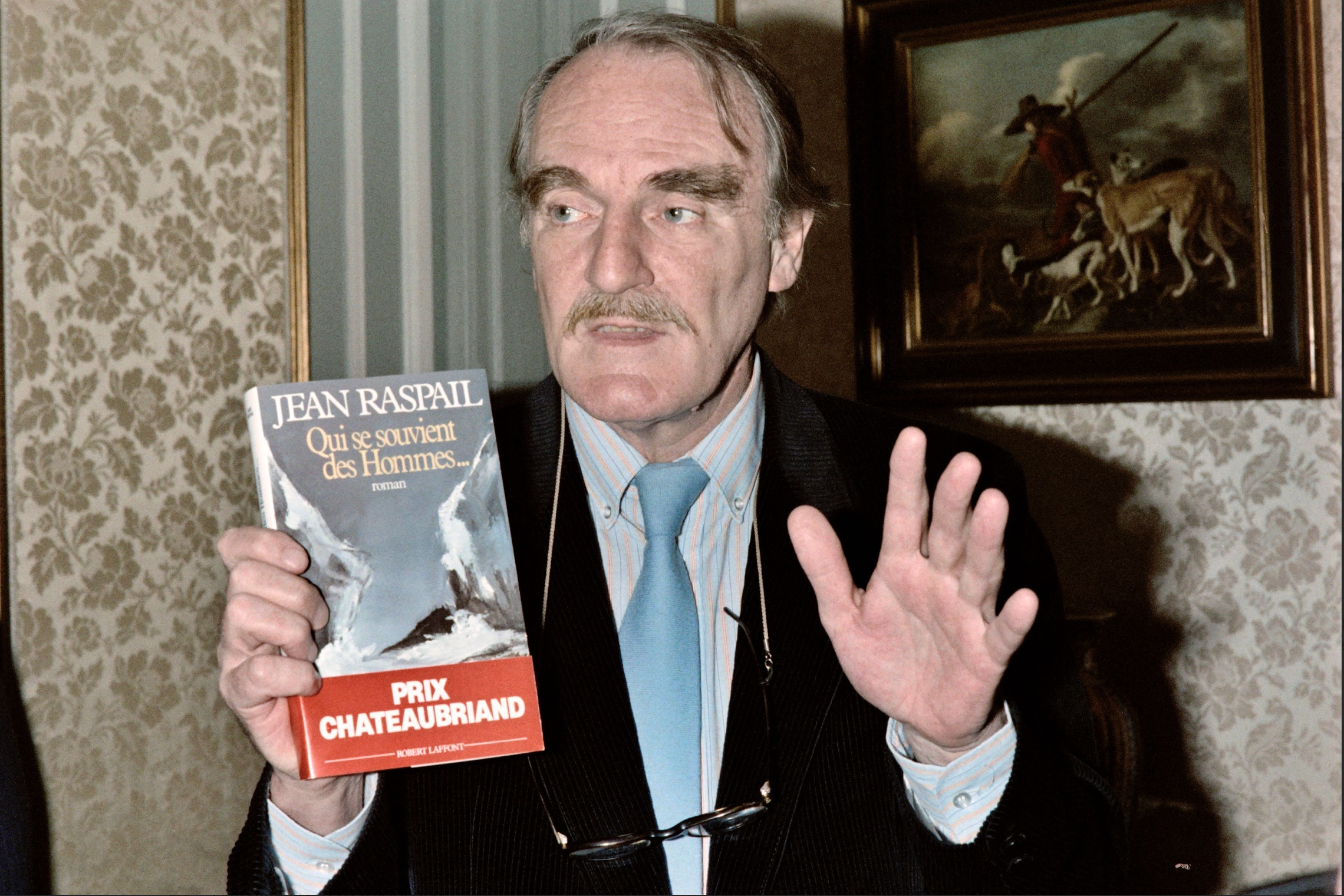
Ethan Rundell is a translator, journalist, alumnus of University of California–Berkeley and Paris’s School for Advanced Studies in the Social Sciences. He has translated over a dozen books, as well as scores of academic articles. After several years in France, he now lives in North Carolina, where he co-founded Vauban Books, which specializes in French dissident literature. Mr. Rundell and Vauban Books recently earned headlines after Amazon briefly delisted Vauban’s 2025 English translation of Jean Raspail’s 1973 novel The Camp of the Saints.
How did you become the face of The Camp of the Saints in America? How did Blowing Rock, NC, of all places, become a hub of dissident French literature?
It's funny. That’s a funny question. First, I would like to think that I am not the face of The Camp of the Saints in America. I would like to think that’s Nathan Pinkoski, that we have a division of labor, and he gets to be the face and interpretive voice, and I’m simply the sinister presence behind the scenes and translator. I think very early on, after starting Vauban Books with [University of Wisconsin-Whitewater’s Professor] Louis Betty, Camp of the Saints was on our radar. I’d read the book first 20 to 25 years ago, in French, and was deeply struck by it. I had also read later the English translation from 1975 and, like many other people, was aware of its fraught career in recent years, how the book had become really deeply politicized in ways that are unusual for 50-year-old novels, and here we were starting this publishing venture specializing in so-far exclusively French dissident literature and translation. What could be a better example of French dissident literature than The Camp of the Saints? So very early on, we began kind of prospecting, attempting to make contacts with the French rights-holders and so forth. After many attempts and much effort and a fair amount of expense as well, we acquired the rights.
As for Blowing Rock, I think no one in Blowing Rock or Boone [nearby home of Appalachian State University]—there are, at most, a handful, maybe six, people in Watauga County who are aware of the fact that Blowing Rock, North Carolina, has now become ground-zero of fairly obnoxious and provocative French dissident literature and translation.
Camp has arguably had a more volatile, politically charged existence in the U.S. than any other novel over the past decade. How would you summarize it?
Well, I think the fortunes of this novel in the United States over the past decade are entirely inseparable from those of the first and now second Trump administrations. Famously, there was this episode in 2019 in which the Southern Poverty Law Center somehow—legally or not, right? That’s an open question with them—gained possession of a trove of emails from Stephen Miller, private emails that he had written over some period of time. And in those emails, Miller is to be found advising editors at Breitbart to talk up The Camp of the Saints, which he thinks is a very important book, and he hopes would have some impact on the immigration debate, if only by spreading his vision of things. And so, the SPLC releases to the press, the story is reported, to my knowledge, first on NPR and then by every other prestige outlet in the country. And as one, they almost immediately issued demands that Miller resign from his posts in the White House in the first Trump administration.
And clearly, in this controversy, if that’s what it was, the real target was not Jean Raspail or The Camp of the Saints, which I think it’s very likely none of the people calling for Miller’s resignation had ever read. It was Miller, and in order to make the charge stick, they had to present the novel in the direst possible way. So, suddenly it became a white-supremacist screed. Obviously, it was consistently called racist and obscene. It was also suddenly paired with this other book, The Turner Diaries. I don’t know if you’ve ever looked at The Turner Diaries, but after Camp of the Saints came out, I’d [still] never seen it.
I’m aware of it on a Wikipedia level, and then these hit pieces.
Yeah, I’d heard of it. Someone actually sent me an e-file of The Turner Diaries—to be clear, not because I was thinking, “Hey, maybe we should bring out The Turner Diaries.” I don't even know why. I was surprised that he did it. And, out of curiosity, I read like the first 20 pages, and it is genuinely obscene. It’s obscene, not just at the level of the story it tells, which is grossly racist and violent, like in the way that I understood what racism meant when I was growing up in the 1980s, not what it means now, which is everything, right? Really, really vile. But, in addition to that, it’s obscene at the level of its prose. It's so poorly written. To compare The Camp of the Saints to The Turner Diaries is—to say that it’s tendentious is a total understatement, because what The Turner Diaries really is, is not a novel, a work of literature. It’s a terrorist manual masquerading as fiction. That’s what its purpose is.
So, the manner in which the Miller–Camp of the Saints controversy was reported was completely dishonest and misleading, and it failed, right? Miller didn’t get ejected from the White House. But suddenly you had this sort of media object, The Camp of the Saints, which had, in my view, little relation to The Camp of the Saints of the book, the text, the work of literature. And having invested so much in this campaign, the people behind it couldn’t very well abandon it.
Tell us about the experience of being delisted and then relisted on Amazon recently.
We released [The Camp of the Saints] on September 16 of last year. There were a lot of people who had placed pre-orders and so forth, certainly better than our other books. And word got around, I guess, and this guy from the Atlantic, Idrees Kahloon, got wind of it and decided this would be interesting. Or someone did and sent him. He learned that we were having this event at Butterworth’s in DC to celebrate the launch of the book. Nathan Pinkoski was going to be there. I was there, and so forth. And you can imagine, this is a juicy journalistic opportunity, because it’s in DC, it’s the Trump administration. It’s Camp of the Saints. Everyone remembers the Miller story, blah, blah, blah. So, he contacted us to see if he could attend. And, initially, I refused. It was like, “What good is going to come out of the Atlantic talking about us?”
And I asked him, “Have you read the book?” And he said, “No.” I said, “Well, read the book and get back to me.” So he read the book, and he got back to me, and he had a set of perfectly fair criticisms of the book, but he also explicitly supported the notion that it should be in print. And we exchanged some emails. He asked me some questions. And so, finally, I thought, “Okay, well, this guy seems okay.” We let him come to the event, and he interviewed Louis and I there. Then he wrote up his piece in the Atlantic. And, again, it’s critical. But I thought it was fair. I was pleased. A few weeks go by, and suddenly this story from the Atlantic is being reported all over the place in France. So, first you get Slate.fr reporting it, and then this kind of up-market online journal associated with the École normale supérieure, which is, in the humanities and social sciences, [France’s] Harvard.
But nevertheless, in intellectual circles, in Paris and France, Le Grand Continent, on the Left, anyhow, is totally respectable. It means something. So, lots of people have read it, including a number of my friends who were kind of surprised about my activities, and that got the attention of some people at Le Monde. This guy Olivier Faye at Le Monde got in touch with me, and he wanted to interview me, and someone from Libération got in touch with me. And I knew these people were hostile. … So I wasn’t going to talk to him, and I said, “No, get lost.” Politely. I said that, but that was what I meant to communicate to these people. But he did the article anyhow. This is a long, really poorly written, kind of clumsy article, just repeating the standard Wikipedia lines of attack, nothing more.
The only interest from the point of view of Le Monde in this article was that it once again attempted to tie the book to the Trump administration. The average readers of Le Monde hate the Trump administration. They want to believe various conspiracy theories. And they also, on the one hand, want to make the Trump administration look bad, but they want to make their enemies in France look bad too, by tying them to the Trump administration. So going through attacking The Camp of the Saints and Jean Raspail and us was a way of saying, “Look, the right in France is compromised. It’s our domestic enemies who are giving our foreign enemies all of their ideas.” All of this is all make-believe, and what have you. But there you go. That was the purpose of it.
And I thought it was probably dead at that point, until that week of April 17, or whatever it was, on a Thursday. Two things happened. One, we had this brief success on X because there was this video, which you probably have seen, of some migrant kid in England creating this giant hole in—I think it’s called a dry-rock wall [dry-stone wall]—somewhere in northern England, right? And he’s confronted by passersby, who say, “What the hell are you doing?” And the migrant kid has no idea why he’s being condemned for destroying this centuries-old piece of rural England. And so, lots of people were citing the beautiful oak door, the lovely oak door passage [from The Camp of the Saints].
And so, my assistant and I took advantage of that, because, after all, we are trying to sell books, and appended our little commentaries to it, and what have you. By that evening, I checked our Amazon ranking, and it had gone up like 1,000 points. And I thought, “Okay, I think it’s doing something. I’ll check again in the morning.” That same day, New York Magazine ran a piece, a hit piece, on basically everyone associated [with Vauban Books]. You were mentioned there with Orbán, and the Hungarian regime, and the recent election in Hungary. And there was this one little paragraph of this author’s incredibly long piece—stupidly long—in which the author decides to attack Rod Dreher and mentions that Dreher had spoken about The Camp of the Saints, and that Orbán himself had, I guess, praised the book. And that was it, right? And so, the next morning, I woke up and I checked our Amazon ranking. It had gone up yet another 1,000 points. I was like, “Yeah, we’re on a roll here. This is good….”
Since the book came out, we’ve consistently been in the top 10,000 best-selling books in the United States. When this began, we were at like 8,000, and then the next morning we’re 7,000, we’re down to like 4,000, so there was movement. There were people buying the book more often than had been the case just a few days before. I went to my office and decided I was going to ignore the whole thing, get some work done. But later I took a break and said, “You know, let’s check in on Amazon. Go see what's happening.” And I went to check, expecting that we were continuing to be moving up the rankings, and the listing was just gone.
What did you see on your screen?
I have a screenshot of it somewhere, but it’s something like, “Sorry, this web page does not exist. Please return to the homepage for another search.” Something to that effect. My theory about what happened—and I don’t know if this is true—is that some middle manager at Amazon, or maybe senior manager, saw the New York Magazine article and realized that the book was being sold on Amazon and was outraged. Or, ultimately, that same person had seen that we were moving up quickly, moving up the ranks on Amazon in the space of a 24-hour period, and was outraged and pulled the plug. In any case, there’s this kind of temporal coincidence that’s striking, but I don’t think we’ll ever know.…
So, I got in touch immediately with our distributor here in the United States, because I have no direct contact with Amazon, but our distributor kind of can. And I asked him what was going on, and he said he would look into it. And, over the course of the weekend, since I was in CC to these emails, we received Amazon’s official response, which is that they had reviewed our complaint. And could confirm they’re not going to revise their judgment, confirming that, in fact, the title had been removed on the grounds that it violated their offensive-content policy, and there we were.
It seemed like it was all over, right? I mean, precisely how is a tiny little publishing house with only two full-time employees going to fight the behemoth that is Amazon? But, still, we had to try, and so my assistant and I talked over the course of the weekend. We decided on Monday morning we had to put out a press release. And so we put out this press release on X and contacted all of our friends there. I think we got lucky, because that Monday was a slow news day. The principal talking point on X hadn’t yet been defined, and nothing very interesting was happening.
Suddenly this press release gained all this traction, and within, I think, 18 hours, we got over 2.5 million views. There was a whole spate of stories. Lots of people were contacting us for comment or interview. One way or the other, Amazon became aware of the fact that this was turning into quite an embarrassing episode for them, and should they not reverse course? It was quite likely to turn into a much more embarrassing and perhaps politically damaging episode for them. So, it was flattering for us, because here we are, this tiny little publishing house just doing what publishers do, about to get almost crushed out of existence by the biggest book retailer in the world. And we were able to leverage, I guess, friendship and reputation, and all that. So we were very grateful to all the people who stepped in to help us out. Yeah, so we were David, and they were Goliath, and we won…. The whole ban, if you want to call it that, lasted from Friday until Monday afternoon….
I first read the novel in 2016. If you do a casual internet search, the most visible sources of information make it sound scary. I asked people, “Is this okay? Am I going to be on some kind of list? Is this beyond the pale?” Is this a common reader experience?
It probably is, in two ways. A lot of people very strongly wish to avoid ever reading this novel. It's a novel they don’t want to read actively, precisely for the reasons that you just mentioned, its reputation. There’s another subset of people who desperately want to read the book, and for those same reasons, they identify with whatever, the sort of sinister reputation that makes it seem dangerous and mysterious and appealing, or they imagine themselves as subject to the same kind of judgment, and thus believe that the book is in some way on their side.
So, yeah, I think that’s entirely true. On the other hand, in brief, our hope was, in a sense, to win it a wider readership that had not necessarily approached the book that way, to get a new hearing for the book, so that new readers who weren’t necessarily wedded to that prior representation would approach it fairly as a work of literature and judge it for themselves by reading it, rather than judge it as a totem or as an artifact of American political conflict, which is what it is in part, right? We wanted to get beyond that. We wanted to defend it as literature, and not just as a byword for one side or the other of some kind of ultimately stupid and Manichaean political division in this country.
Would the controversy be lessened if Norman Shapiro hadn’t used the name “Turd-Eater” in his 1975 translation?
There’s a lot to be said about the two translations. Actually, I’m almost never asked questions about that, which is fair enough, because if you don’t have the French, you're not going to really be able to assess them.
So, just to answer your question, “Turd-Eater” is not the word in French. That’s not what Raspail says. He uses a synonym, but “coprophage” is the same word in both languages, same Latin origin. It’s usually employed in the context of entomology, or the study of beetles, whatever that’s called, but it’s a different register. So “Turd-Eater” is vulgar, silly. It’s funny, it’s childish, it’s crude. “Coprophage” is ironic. It's applying a scientific label to a disgusting practice, right? There’s humor in it, but there’s also distance and judgment.
Norman Shapiro, throughout his translation, opted for the demotic turn. He made things cruder than they were in Raspail. He substituted for Raspail's humor what I must suppose was Shapiro’s humor. He translated the book, in my view, very deliberately for the American readership of his time. I like to joke that, reading Shapiro, you get the impression that when he was tasked with translating this book, he said, “Okay, this is too French. I want this book to be serialized in Playboy magazine. I’m going to translate it for the sort of modal Playboy reader.” That’s not how I approach translation, particularly when I’m dealing with important authors, stylists. I think the reader picks up the translation. Readers don’t just want the content, they want the voice. And so I attempted to reproduce, as far as possible, the voice of the original in English.
But there’s another respect in which I think Shapiro’s translation lent to the controversy. On at least two occasions, Shapiro employs the n-word in his translation, and in passages where it does not occur in the French original. There’s only one passage in the French original where you find the n-word, and it’s employed by an African diplomat in Paris in reference to his coethnics from Africa. And it appears in quotation marks.
The U.S. has a better free-speech reputation than other countries in the Anglosphere. Could you compare the existence of Camp in the United States to some of the other major anglophone countries?
Yes, the United States does have this reputation, and in large measure, I think it’s well deserved. On the other hand, in this particular instance, it’s kind of ironic, because my impression is that Camp has fared much more poorly here than it has in these other countries. Translations of Camp exist in various languages. I’m familiar only with a few of them, like the German translation, the Italian translation,
When we released the book, we thought, “Okay, we’re probably going to have problems in Great Britain. Our distributor is going to dump us. Or Amazon’s going to dump us.” You know something’s going to happen, and it didn’t. And not only that, more surprisingly, the first major reviews that we received for the book were in Great Britain. And oddly enough, the same was true of our [Renaud] Camus work. Our Camus books have gotten pretty good press in Great Britain. In the United States, to this day, they still haven’t.
I think this is symptomatic of the fact that it’s in the United States, specifically, that Renaud Camus and his expression, the “Great Replacement,” and The Camp of the Saints have been assigned this status as totems. Totems for what is evil from a progressive point of view, there’s this progressive narrative. There are good guys, the progressives, and then there are the bad guys, always expanding lists of bad guys, and the bad guys also have their literary counterparts in, specifically, Camus and Raspail. And if you can associate your political opponents with that literature, you discredit them, right? And so, this narrative has been crafted for specifically American political ends, and it only makes sense, I think, that it is here that that narrative must be most fiercely defended. In the UK, it’s just an import, right? In the UK, all they do is ape what happens here, and now they ape it with a delay of three or four years.
Have you or Vauban Books been threatened, apart from the media smears?
Not yet. No, no, no. And we were worried about that, not so much physical threats, though who knows, but Louis [Betty] is a sitting professor, and so it seemed like there was a possibility for retaliation. [The intellectual historian and editor of Vauban’s Towards a Conservative Left] Michael Behrent is a sitting professor. Both of them have tenure, but still, these days, I’m not sure that really matters as much as it used to.
There have been no professional repercussions for either of them, at least that they know of, and there have been none for me. I don’t really depend on anyone in that sense. And so, it’s less obvious in my case, but down the road, we’ll see what happens. I’ve gotten some weird emails, of course, but nothing threatening to hurt you or anything like that. No, just weird stuff, vague stuff. It’s easy to write me, send an email. And, besides, I live in an open-carry state. It’s very generous with all kinds of things in that connection. So, some reassurance there. But no, no, I don’t mean to exaggerate that point. There’s been no reason so far to worry about anything.
On that note, there will come a time when the Democrats will regain power, and their partisans will likely have near-total institutional control again. When that happens, what will it mean for Vauban and Camp’s availability in the U.S.?
My general answer is, ‘Who knows?’ The next answer is, I would not in the least be surprised that when that day comes, Camp has disappeared down the memory hole, and maybe we are just consistently dropped across the board by Amazon, in particular, maybe our distributor in Europe. All kinds of things like that can happen to make it difficult or impossible for us to do business.
The truth is, I’m not radical. My views are just the standard views of 99.999 percent of humanity throughout the entirety of human history, and here, too, on the Left in this country. Until 15 years ago, I used to be a Democrat. I think that these people, the radicals, and in French, there’s this expression “the radical center.” That’s who they are. It’s the center that’s insane. There should be an SPLC that’s studying the center.
Two other quick responses to the final question. When we started Vauban Books, we saw it—we describe it as such on our website—as a project in translation, a counter-project. Let’s say, “Well, should the political tides turn, and everything come crashing down? And we were prevented from engaging in business like a normal company?” Projects have beginnings, middles, and ends. It will be an honor to have been associated with this particular project in the time that we were able to pursue it. And that’s fine. That’s the way it goes. It’s not going to hurt my feelings.
Subscribe Today
Get daily emails in your inbox
So that’s sort of our position, the pretense that ours is a political and literary culture that’s still interested in freedom of expression allows us to exist. But I think, effectively, unfortunately, it’s just that. It’s a pretense, and once the powers that were and still are in Europe—I like to think of as the empire in exile—returns to its throne in Washington, DC, I think they’re quite ready now, in a way they weren’t five or 10 years ago, to dispense with it altogether. And then, when that happens, I presume that we will receive their attention.
This interview has been condensed for brevity and lightly edited for clarity.
Michael O’Shea is an American-Polish writer and translator. He is a former Visiting Fellow at the Danube Institute in Budapest.