Burnham’s First Speech as Labour Leader Long on Promises, Short on Details
The man with a plan seems strangely reluctant to share his concrete policies.
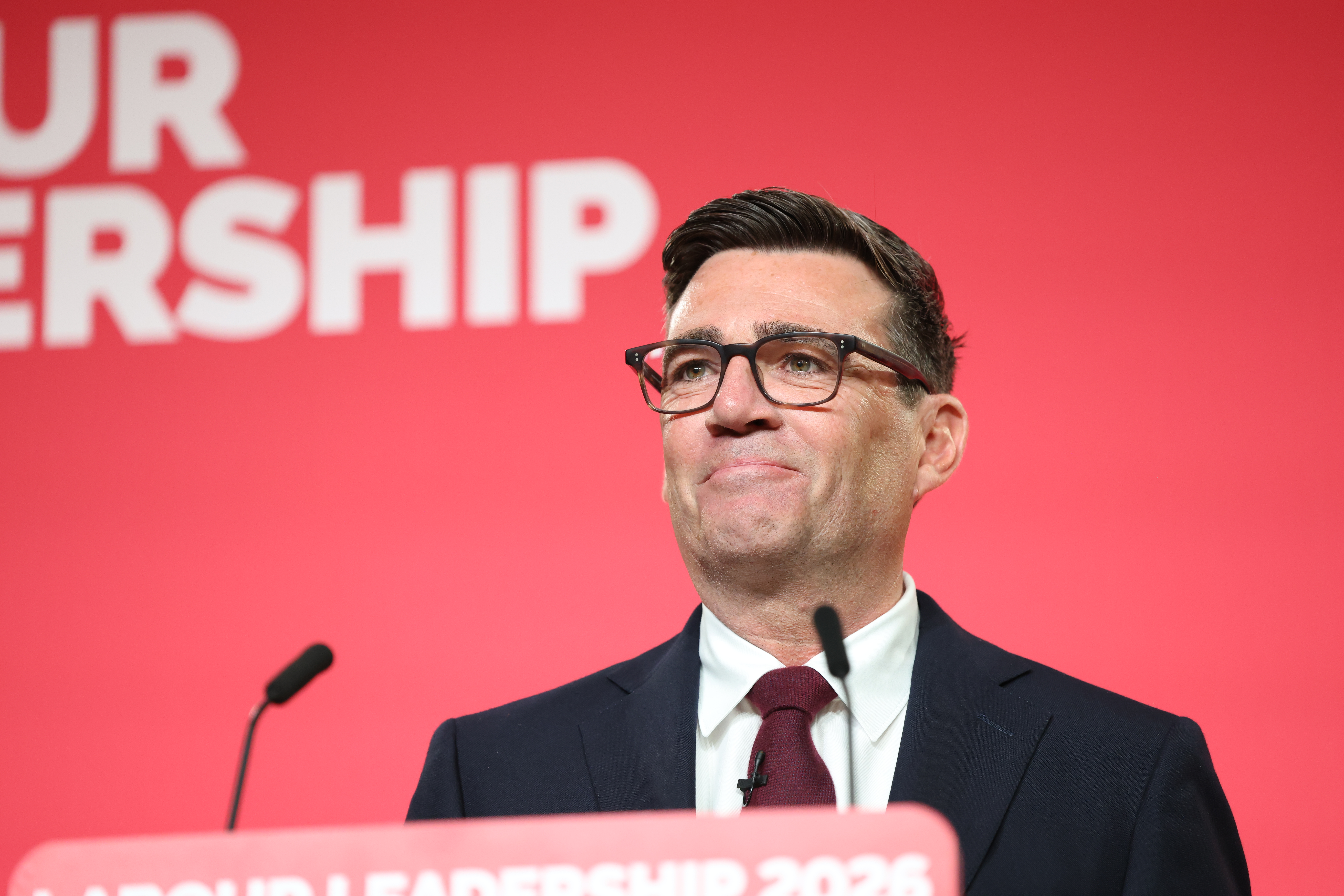
Andy Burnham’s first speech as leader of the Labour Party today told us little about what he intends to do when he becomes UK prime minister Monday and everything about his penchant for platitudes.
And his tendency to repeat himself. He reaffirmed his promise to deliver “good growth in every postcode and hope in every heart.” And, no doubt, a chicken in every pot. What this means in practice is no clearer now than when he first uttered it last month.
He is going to “build a new politics,” abolish “factionalism,” end “point-scoring” in political discourse. Burnham promises to “take back control,” though not in the Brexit sense. He insists that he will “take power back from Westminster and Whitehall and give it to the place where you live.” No one knows precisely what this means either. He insists that he “has a plan” but seems curiously reluctant to tell us what it is.
The seventh occupant of Number 10 in a decade is going to be the prime minister for “all places,” not just the North. Well, that is good to hear, though it is what every incoming political leader says. Ditto his promise to “unite people in a common cause.”
He is going to solve a conundrum of social welfare, old people having to sell their homes to afford care. But so were the last six prime ministers. Indeed, Boris Johnson proposed an £86,000 lifetime cap on care costs, financed initially through the Health and Social Care Levy. The reforms were delayed and ultimately scrapped by Chancellor Rachel Reeves in 2024 before they came into force.
The prime minister–designate says Britain took a wrong turn in the 1980s (a reference to the Conservative prime minister Margaret Thatcher) and that four decades of “neoliberalism” have led to deindustrialization, stagnant wages, and wealth and power being concentrated in the hands of fewer people.
That latter point is probably true, though income inequality has actually been falling in recent years according to the Gini coefficient, the international standard measure of income inequality used by the Office for National Statistics. Wealth inequality has increased over the longer term, largely because of the inflation of real estate and other financial assets following the Bank of England’s policy of quantitative easing (that is, money-printing) after the 2008 financial crisis.
Burnham did not mention the wealth tax that many expect him to introduce next week. But he did say he would be “boldly and authentically Labour” and has recently suggested there is “room for movement” on tax. In other words, he'll confirm the old Tory chant that “dogs bark, cats meow, and Labour puts up taxes.”
But if this is his plan for growth in every postcode, he is likely to be disappointed. Most European countries that introduced wealth taxes—such as Sweden, Denmark, and Austria—have since abolished them, mainly because they discourage investment and raise little revenue.
Switzerland retains a relatively modest wealth tax, but it also has no federal capital gains tax and no inheritance tax on families. It is not, perhaps, a model Burnham will wish to emulate.
Subscribe Today
Get daily emails in your inbox
But Britons can certainly expect to pay more tax in the future, even though successive governments have increased the tax burden to levels not seen since the Second World War. Business taxes have discouraged employment, personal taxes are undermining ambition, and renewables levies have burdened British industry with some of the highest energy prices in the world.
Burnham says he is opposed to the deindustrialization of the North of England. His recipe for recovery is to bring transport companies and utilities into public ownership or control.
Well, good luck with that. Burnham likes to paint himself as a continuity candidate, building on Labour’s 2024 manifesto. But the only continuity, on this showing, will be Great Britain’s continued economic and social decline.