War and ‘Covert Action’ Are Not How to Deal With Iran
The track record of such interventions in the Middle East speaks for itself.
The prospect of President Donald Trump pursuing regime change in Iran has animated the most hawkish voices in the establishment. But American war-weariness has forced the usual suspects to refine the art of apologetics. Rather than calling for “boots on the ground” to liberate the Iranian people, many now argue the same result can be achieved through covert methods. Some assert, without a shred of evidence, that a large-scale strike can topple Tehran’s rulers without American troops ever setting foot in the country. Others avoid the question of what regime change would look like altogether, fearful that Americans will not be pleased with the answer. As the Wall Street Journal editorial board recently put it: “There are prudential questions on the best ways to help topple the regime. But helping the Iranian people end this regime is the right goal that would make America and the world safer.”
Clearly, neocons specialize in rhetoric, not sound policy. Whether pursued through covert operations or “decisive” military action, regime change in Iran is incompatible with America First principles. Such a pursuit would not only undermine American interests but also degrade the nation’s character.
To evade this charge, the hawks have increasingly shifted from their usual calls for open war to proposals for covert subversion, hoping the public will be more receptive to the latter. But this rhetorical pivot fails to resolve the underlying problem: The distinction between military intervention and clandestine interference is specious, more cosmetic than substantive.
The proponents of such policies rightly assume that Americans will find covert action more attractive, since it is less heavy-handed and resource-intensive. The effectiveness of this tactic, however, rests on the public’s unfamiliarity with Washington’s lengthy history of failed CIA operations in the Muslim world. If Americans knew that their government had already attempted covert regime change in the Middle East many times, and that in most instances it produced the opposite of the intended effect, they would unequivocally reject the continuation of such a policy.
The hawks, by contrast, are acutely aware of this history. They simply refuse to acknowledge it because their rhetorical maneuver would instantly lose potency. This makes clear that their adoption of this tactic stems not from a genuine change in belief, but from a recognition that overt military action has an untenable track record and is deeply unpopular among Americans. Former National Security Advisor John Bolton is a case in point: He claims to oppose “boots on the ground” but supports using “intelligence resources” to bolster Iranian opposition movements.
What Bolton conveniently omits is that CIA-orchestrated regime change produced the conditions that gave rise to today’s Islamic Republic. In 1953, the CIA’s Operation Ajax ousted Iran’s Prime Minister Mohammad Mosaddegh. The agency deployed propaganda, bribery, and paid protests to sow internal discord and restore the shah to power on behalf of Western oil interests. In this very narrow respect, the operation was a success. Yet in a broader sense, it proved a strategic failure. It fostered deep resentment and cynicism toward the shah, whom many Iranians came to view as a Western puppet. That distrust fueled nearly three decades of anti-American sentiment that culminated in the 1979 Islamic Revolution and the end of imperial rule.
Likewise, Saddam Hussein’s rise to power cannot be fully understood without reference to American intelligence. In 1963, the CIA supported the Iraqi Arab Ba’ath Socialist Party—of which Hussein was a trusted operative—in its overthrow of Prime Minister Abdul Karim Qasim. After the party consolidated power in 1968, Hussein went on to become the country’s leader roughly a decade later. And despite his authoritarian rule, he received vital U.S. intelligence support during the Iran–Iraq War of the 1980s. The American intelligence apparatus spent the second half of the 20th century enabling, directly and indirectly, one of modern history’s most brutal dictators. Then, on the basis of faulty intelligence, it sent Americans to die toppling his regime in 2003.
Simply put, the use of “intelligence resources” to induce regime change in the 1950s and 1960s created the problematic circumstances of today. Indeed, Bolton’s preferred method of regime change has already been tried and tested. Despite its practical differences from military intervention, it tends to produce the same outcome: increased regional instability and diminished American resources. Even so, advocates of regime change insist these practical differences are meaningful enough to justify the use of covert means. This obstinate refusal to learn from the mistakes of the past would be laughable, were it not so tragic.
Meanwhile, other establishment hawks are taking a more direct approach, openly urging the president to take overt military action against Tehran. These voices often appeal to people’s emotions to garner support for their interventionist causes, regularly appearing on television to discuss the Iranian regime’s horrific atrocities. One example is the neoconservative talk host Mark Levin, who in a recent interview described Iran as a “concentration camp” in which people are “executed summarily.” No serious observer of the situation can deny that Iran’s security forces are violently suppressing protests. But from this premise Levin wrongly concludes that Americans should risk their lives to “take out” the supreme leader and restore power to the Iranian people. That view is misguided—indeed, it is emblematic of the post–Cold War progressive universalism that shifted America’s foreign policy focus from well-defined national interests to gauzy global ambition.
Interventionists also overlook the extent to which restrainers can rely on similar emotional appeals. The consequences of the Global War on Terrorism reach far beyond military failures or the erosion of domestic civil liberties, as serious as those are. The idealistic crusade to stamp out terrorism provoked retaliatory violence that cost both civilians and American troops their lives. The most recent example occurred last fall, when an Afghan national who had served with a CIA-backed paramilitary group allegedly attacked two National Guardsmen in Washington, DC, killing one and severely injuring the other. This was not an isolated incident, but part of a much larger pattern rooted in the foreign policy establishment’s impulse to reshape the Muslim world by force of arms.
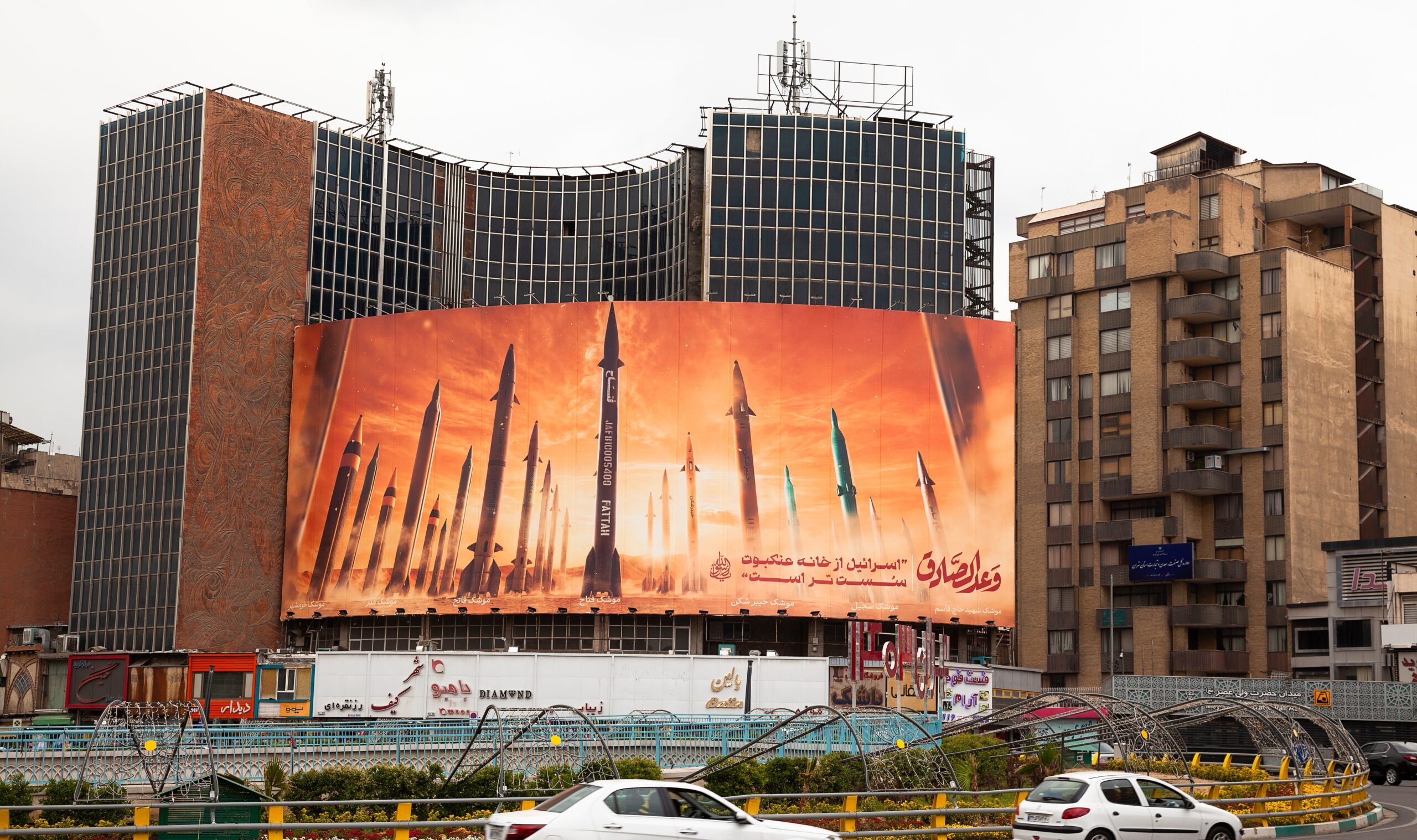
Nevertheless, the hawks continue to treat Iran as an opportunity to pursue another fruitless venture in the Middle East. This time, though, their country of choice has a population of over 90 million, an opaque nuclear hedging policy, and the largest ballistic missile program in the region. To put it bluntly, the idealism of the interventionist camp knows no limits.
To make matters worse, the camp’s champions are ignorant of another great sacrifice that must be made to realize their vision of regime change: the very foundations of America First, at least as the Founders would have understood it. To quote the late Angelo Codevilla in his final book, America’s Rise and Fall among Nations, the original meaning of
America First, namely pursuing what benefits our American character and advances our legitimate interests—in short, fully minding our own business while leaving other people to mind theirs—was the basis of the United States’ successful foreign policy from 1815 to 1910, as best described by John Quincy Adams and carried out by his successors. It is the foreign policy by which America grew great in peace. It fulfills the Declaration of Independence’s promise to take up our “separate and equal place among the powers of the earth.” It is common sense.
The implications here are profound. Codevilla contends that no U.S. foreign policy decision, regardless of what legitimate interests it may serve, can properly be called America First unless it benefits the character of the nation. And what is a nation’s character if not the culmination of those moral qualities distinctive to its people? The Founders of this particular nation, despite some of their differences, agreed that morality is deeply rooted in a respect for the God-given rights of every individual. Indeed, they viewed the protection of individual liberty as a core tenet of republican governance. But it would be wrong to conclude from this that they had little regard for the collective rights of nations.
The Founders held that every nation has a right to establish its own system of government, free of foreign imposition. Hence the Declaration’s assertion that it was necessary for Americans “to assume among the powers of the earth, the separate and equal station to which the Laws of Nature and of Nature’s God entitle them.” These words cannot be reduced to mere rhetoric. Instead, this universal truth must be accepted as “the seed from which the whole tree of American statecraft has grown.” One of the nation’s greatest statesmen and the author of the Monroe Doctrine, John Quincy Adams, believed that this truth implied a foreign policy principle essential to any true republic: “That each Nation is exclusively the judge of the government best suited to itself, and that no other Nation may justly interfere by force to impose a different Government upon it.”
Pursuing regime change for the sake of installing a more favorable government is manifestly unjust. And by its very nature, an unjust act is not only immoral but also incapable of benefiting a nation’s character. By agitating for U.S. intervention in Iran, some on the right have sacrificed the very America First principles they claim to uphold, namely, the principle that a nation’s foreign policy ought to “advance its legitimate interests” in a way that preserves its moral fabric. This is an unfortunate development, and its gravity should not be taken for granted. When the American right abandons those distinctive values that have defined this nation since its founding, no one will be left to defend them.
A few sober voices in Washington continue to cherish these uniquely American values, and many labor within the administration to conserve them. One can only hope the president stands among their number.
At the moment, Trump’s rhetoric on Iran is at least concerning. Speaking with POLITICO a few weeks ago, the president said, “It’s time to look for new leadership in Iran.” Shortly thereafter, he deployed fighter jets, air-defense systems, and a carrier strike group to the region, along with a veiled threat: “We have a big force going toward Iran. I’d rather not see anything happen, but we’re watching them very closely.” After the carrier’s arrival, Trump warned in a Truth Social post that if Tehran did not quickly negotiate a deal to end its nuclear program, he would authorize an attack “far worse” than Operation Midnight Hammer—the June offensive in which American B-2 stealth bombers struck three Iranian nuclear facilities.
It may be tempting to dismiss these comments as bluster and the deployments as mere signaling, but the president is playing a very dangerous game. He has presented Tehran with what is in effect an ultimatum: either abandon uranium enrichment, halt ballistic missile production, and end support for regional armed proxies, or prepare for war with the United States. The fundamental problem is that these conditions constitute the entirety of Iran’s leverage in its geopolitical struggle to sustain multipolarity with Israel in the Middle East. The notion that Tehran might “quickly” agree to such terms is wishful thinking. Any sober assessment of the situation points to the negotiations breaking down. With U.S. warships stationed in the Arabian Sea, Trump may be forced to make good on his promises. What happens after that? Almost certainly nothing good.
Ayatollah Ali Khamenei has already cautioned that any U.S. attack would trigger a “regional war.” Trump’s response: “Hopefully, we’ll make a deal. If we don’t make a deal, we’ll find out whether or not he was right.”
At the same time, Trump appears conflicted over whether to use military force to decapitate the regime. According to officials cited in a recent New York Times report, the president is eager to reach a deal with Tehran, and “telegraphing the threat of military action was intended to drive the Iranians into a negotiation.” His aides have given him a range of military options that could “possibly bring about a change in government.” Trump, however, is concerned about the viability of these options. He wants to know whether it is possible for the regime to be removed without dragging America into another Middle East quagmire.
In principle, such an operation is imaginable. In practice, the historical record is unforgiving. From Iraq to Libya, regime-change wars in the region have only led to open-ended conflict and destabilization. But the president appears mindful of this reality, which explains both his reluctance to authorize any large-scale strikes, “decisive” or otherwise, and his desire to engage in diplomacy.
Subscribe Today
Get daily emails in your inbox
Public reporting indicates four factors shaping Trump’s calculus. First, the pretext for any military action has already evaporated: The Iranian government’s brutal crackdown largely extinguished the peaceful protests Trump once cited to justify a decapitation strike. Second, his top advisers warned that U.S. forces in the region lack the military assets needed both to sustain a large-scale attack and to withstand potential retaliation. Trump has since moved assets to the Middle East, but to what extent is he willing to weaken America’s posture in other theaters? Third, two key regional allies—Saudi Arabia and the United Arab Emirates—have ruled out the use of their airspace for a potential U.S. strike. Fourth, he was made aware that any serious effort to topple the regime, whether labeled “decisive” or not, would likely trigger a prolonged conflict. Taken together, these realities lie at the heart of the president’s hesitancy to greenlight the strikes.
At its core, the Trump foreign policy doctrine rejects the establishment’s legacy of forever wars that fail to serve American interests and, by extension, the pursuit of regime change in Iran. Two months ago, the administration released its 2025 National Security Strategy, in which it expressed a commitment to hemispheric defense and to ending wars “quickly and decisively, with the lowest possible casualties to our forces.” And in keeping with this new doctrine, the administration captured Venezuelan dictator Nicolás Maduro, in a two-and-a-half-hour mission that ended with zero American lives lost. Time and again, the president has illustrated an aversion to long, drawn-out conflict—sometimes to the chagrin of his most hawkish advisers and secretaries. Let us hope he remains so.
Editor’s note: This article has been changed to reflect the correct publication dates of the Times report and the National Security Strategy and the timing of Khamenei’s statement.