The Rise of German Nationalism Exposes Washington’s Delusions
More hysteria can only hurt the U.S. approach to Europe and the Ukraine war.
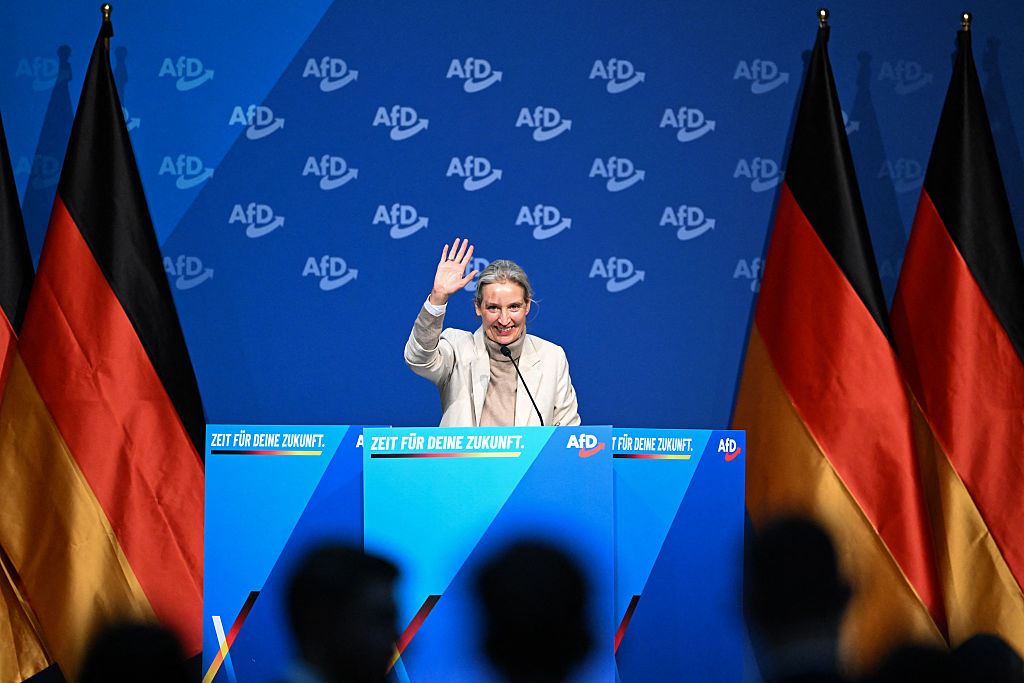
The recent electoral surge of the right-wing Alternative for Germany (AfD) party, which secured 20.8 percent in February's snap election and won state elections in Thuringia last year, has predictably triggered alarm bells throughout Washington's foreign policy establishment. The usual suspects are warning of a new Nazi threat, the collapse of the transatlantic alliance, and the end of Western civilization as we know it. But beneath the hyperbole lies a more complex reality that American policymakers would be wise to understand rather than reflexively condemn.
Let’s be clear about what's happening. The AfD’s rise is not some inexplicable resurgence of fascism but rather a predictable political backlash against decades of failed policies—economic stagnation in eastern Germany, botched immigration policies, and Berlin’s costly entanglement in the Ukraine conflict. When the mainstream parties offered voters more of the same, voters looked elsewhere.
Washington’s foreign policy blob has responded with its standard playbook: demonize, isolate, and lecture. Yet this approach fundamentally misunderstands both German politics and American interests. The same establishment that assured us NATO expansion posed no threat to Russia, that the Iraq War would be a cakewalk, and that Afghanistan could be turned into a democracy now wants us to believe that AfD supporters are crypto-Nazis rather than ordinary Germans fed up with bearing the costs of extreme liberalism and America's geopolitical adventures.
The AfD’s supposedly pro-Russian stance has become the primary focus of establishment anxiety, and here the panic reaches its crescendo. The party opposes sanctions on Russia, calls for an end to weapons deliveries to Ukraine, and advocates diplomatic engagement with Moscow. To the Beltway consensus, this represents treachery. To realists, it represents Germans acting in their perceived national interest.
Germany imports its energy, and Russian gas was both cheap and reliable until Washington pushed for a confrontation that Germans never asked for. The AfD's opposition to the Ukraine war is not driven by admiration for Russian President Vladimir Putin—though some members certainly harbor such views—but by a cold calculation that bleeding Russia white in Ukraine is not worth Germany's economic security. Right or wrong, this is a legitimate policy position, not evidence of Kremlin control.
Yes, there are concerning ties between some AfD figures and Russian operatives. But let's not pretend this is unprecedented. Gerhard Schröder, the former center-left chancellor, sat on the boards of Russian energy companies. German business has been deeply embedded with Russia for decades with the blessing of every government. The selective outrage now directed at the AfD while ignoring decades of establishment Ostpolitik is transparently political.
The real question for American interests is what the AfD's rise means for NATO and European security. Here, the conventional wisdom gets it backward. The foreign policy establishment warns that AfD's skepticism toward NATO threatens the alliance. But NATO’s crisis predates the AfD and stems, in part, from a more fundamental problem: Most NATO members, including mainstream German parties, won't adequately fund their own defense.
Consider the poll showing that 61 percent of AfD supporters would fight to defend Germany, compared to just 22 percent of Green Party supporters—the very same Greens who most vocally support the Ukraine war and German rearmament in theory. The sovereigntist right wants a strong national defense but opposes using German resources to fight America's proxy war with Russia. The establishment left talks tough about standing up to Putin but won't personally risk anything and opposes conscription at home.
From a purely American strategic perspective, which is more valuable: European allies who will fight for their own countries but not for Washington's geopolitical projects, or allies who enthusiastically support American interventions but won't fund their own militaries or risk their own soldiers?
For decades, American foreign policy has been predicated on the notion that European interests automatically align with American interests, and that Germany in particular should subordinate its economic and strategic calculations to whatever Washington currently defines as the “rules-based international order.” This was always a delusion, and the AfD’s rise makes that delusion harder to sustain.
German voters are increasingly questioning whether their interests are served by confronting Russia, by accepting unlimited immigration from the Middle East and North Africa, or by deferring to Brussels on matters of national sovereignty. These are legitimate questions for German voters to decide, not matters for Washington to dictate. The more the American foreign policy establishment demands German compliance with its agenda, the more it will fuel exactly the kind of nationalist backlash represented by the AfD.
If we strip away the moralizing and focus on concrete American interests, what does the AfD surge actually mean?
First, it makes clear that Europe will not automatically be a reliable partner for American military adventures. The Afghanistan and Iraq experiences already taught this lesson, but apparently it needs reinforcing. Europeans will not fight America's wars in Asia or the Middle East, and increasingly they won't even support proxy conflicts on their own doorstep if the costs become too high.
Second, it demonstrates that NATO’s conventional deterrent depends on political will that may not exist. No amount of Leopard tanks or F-35s matters if the populations of NATO countries are unwilling to use them. The alliance needs to reckon with this reality rather than papering it over with empty declarations of unity.
Third, it suggests that forcing a choice between relations with Russia and relations with America may not produce the answer Washington expects. Germany has legitimate economic interests in Eurasia that the United States cannot and will not compensate for. Demanding Germans choose between their own prosperity and America’s strategic goals is likely to backfire.
Rather than treating the AfD as a threat to be contained, American policymakers should view it as a signal that current policies are unsustainable. This doesn’t mean embracing the AfD’s agenda wholesale or ignoring genuine concerns about extremist elements within the party. It means recognizing that German voters have agency and that their revolt against the status quo contains legitimate grievances that won’t disappear through demonization.
A realistic American policy would accept that Germany will pursue closer economic relations with Russia when the Ukraine conflict eventually ends, that Berlin will prioritize European over global military commitments, and that German voters will not indefinitely subsidize American grand strategy at the expense of their own economic interests. These are features of a multipolar world, not bugs to be fixed through more American pressure.
The alternative—doubling down on a failing strategy, escalating tensions with Russia, and demanding ever-greater German compliance—will only strengthen the very forces Washington claims to oppose. The AfD thrives on the narrative that mainstream parties serve foreign interests rather than German ones. Every American attempt to dictate German policy choices validates that narrative.
Subscribe Today
Get daily emails in your inbox
The AfD’s rise challenges comfortable assumptions in Washington about European subordination to American leadership. The establishment’s hysterical response suggests they prefer the comfortable delusions to uncomfortable reality. But American interests are better served by clear-eyed realism than by wishful thinking.
Germany will not become the Fourth Reich. NATO will not collapse because Germans question whether their prosperity should be sacrificed to support an unwinnable proxy war. And the transatlantic alliance will better survive if it's based on genuine shared interests rather than enforced conformity to Washington's agenda.
The question is whether American policymakers can adapt to this new reality or whether they will continue insisting that any deviation from their preferred script represents an existential threat. Based on Washington's track record, betting on wisdom would be unwise. But one can always hope.