Then Traditionalists’ Eyes Were Opened, and They Realized They Were Naked
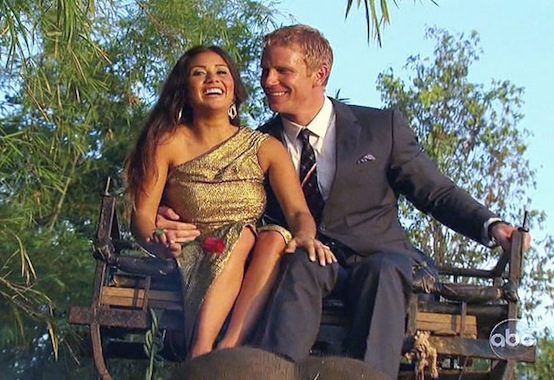
Probably since Maisie Allison brought him up in her recent survey of post-movement conservatism, I’ve had Peter Viereck on the brain again. I thought of him in, of all places, the grocery checkout line. My eyes had wandered toward the cover of People magazine, currently featured on which is the happy-seeming couple Sean Lowe and Catherine Giudici, of ABC’s The Bachelor fame. Lowe, evidently, is a “born-again virgin” and has abstained from sexual activity since college. Hence, as People’s snappy headline writers tell it, the couple is “honoring his traditional values,” meaning: “No sex until ‘I Do.’”
I don’t think I’m out on a limb in assuming that 1) many shoppers will react to that cover with an “Aww, isn’t that sweet and romantic and old-fashioned?” sort of condescension; and 2) such condescension would rightly upset traditionalists. Indeed, if you actually delve into the cover story (I was conducting research, people!), you’ll find Lowe explaining, “I lived life kind of selfishly for a long time, and I reached a point where I was tired of being selfish. I wanted to live my life the way I know it to be right. It’s a personal choice for me.”
“A personal choice”: just another option on the lifestyle menu of modern liberal society.
Isn’t that sweet and romantic and old-fashioned?
I can’t decide if it’s a left-handed compliment or a knockout punch.
Which is why I thought of Viereck.
In a 1974 appendix to his study Conservatism Revisited: The Revolt Against Ideology, Viereck wrote that classical conservatism, of the mostly British but also French variety, is “an inarticulate state of mind and not at all an ideology. Liberalism argues; conservatism simply is.” Once conservatism becomes conscious of itself—becomes aware that it is a thing set apart—it changes irrevocably; it becomes another species of rationalism. Viereck was writing in a sociopolitical context, in which classical conservatives recoil from Rights of Man universalism and other logical abstractions. But the observation applies just as well, I think, to traditional values in modern Western societies.
That couples should abstain from sex until marriage used to be more than an imperative; it was a norm, a widely-shared expectation of behavior. Today it is a value—inculcated and professed as against the more lax standards of the mainstream. It is joined to a narrative about honor and degradation. It is an argument, rather than something that simply is.
This no more presages the disappearance of the practice of abstaining from sex until marriage than it does the disappearance of any other rational, self-conscious ethical or political blueprint. It does, however, mean that its adherents must realize they are tending to something inorganic and exposed to a “torrent of change,” like Chesterton’s white post. It means they must become radical and set apart.