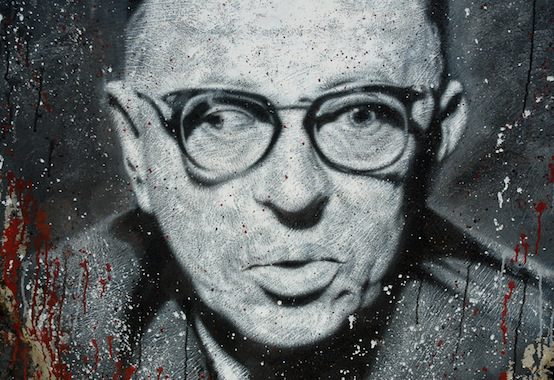
Jean-Paul Sartre | Abode of Chaos / Flickr

The cult of redemptive violence is one of the darkest currents in the political thought of the last few centuries. Although they were not squeamish, ancient writers on violence such as Thucydides, Xenophon, and Tacitus had no notion of killing as a source of meaning, rather than the means to specific ends.

Even Machiavelli, who condemns princes’ failure to deal decisively with enemies, does not suggest that they should derive any personal satisfaction from “execution”. On the contrary, Machiavelli argues that violence must be governed by reasons of state rather than the whims of a monster.

Machiavelli’s arguments for a rational economy of violence were swept away by the French Revolution. In a world turned upside down, killing and risking death came to be seen as constitutive of the resolute individual, rather than as necessary evils. Hegel’s so-called dialectic of master and slave is the most sophisticated articulation of this idea.

The Romantic understanding of violence as the crucible of the self had advocates on the Right, the Left, and those somewhere in between. In the 19th century, its protagonists included both Maistre and Bakunin. In the first half of the 20th century, mortal danger found its  propagandist in Sorel, its philosopher in Heidegger, and its poet in Jünger (and, perhaps, its president in Theodore Roosevelt).

In the decades after World War II, however, the cult of violence found its home on the European Left. In his preface to Frantz Fanon’s The Wretched of the Earth, Jean-Paul Sartre described the anti-colonial terrorist as follows:

…this new man begins his life as a man at the end of it; he considers himself as a potential corpse. He will be killed; not only does he accept this risk, he’s sure of it. This potential dead man has lost his wife and his children; he has seen so many dying men that he prefers victory to survival; others, not he, will have the fruits of victory; he is too weary of it all. But this weariness of the heart is the root of an unbelievable courage. We find our humanity on this side of death and despair; he finds it beyond torture and death. We have sown the wind; he is the whirlwind. The child of violence, at every moment he draws from it his humanity. We were men at his expense, he makes himself man at ours: a different man; of higher quality.

Sartre was both revered and reviled for this assertion. So it’s interesting to watch him grapple with its implications just a few years later. In 1974, Sartre made a pilgrimage to Germany, where he visited the imprisoned Andreas Baader, leader of the murderous Red Army Faction. After a brief meeting, Sartre held a press conference at which he denounced the inhumanity of West Germany’s treatment of the martyr. At least in the mainstream press, Sartre’s accusations were widely understood as a confession of moral bankruptcy.

The release of new documents complicate this picture. According to a transcript of the meeting acquired by Der Spiegel, Sartre actually tried to convince Baader to abandon terror. Here is an excerpt from their conversation:

Sartre: The masses — the RAF has undertaken clear actions that the people don’t agree with.

Baader: It’s been established that 20 percent of the population sympathizes with us …

Sartre: I know. The statistics were prepared in Hamburg.

Baader: The situation in Germany is geared to small groups, both in terms of legality and illegality.

Sartre: These actions might be justified for Brazil, but not for Germany.

Baader: Why?

Sartre: In Brazil independent actions were needed to change the situation. They were necessary preparatory work.

Baader: Why is it any different here?

Sartre: Here there isn’t the same type of proletariat as in Brazil.

What’s happening is that Sartre is trying to put the genie of redemptive violence back into the bottle of rational control. Violence, he argues, can be justified when it contributes to a discernable goal, namely socialist revolution. Yet it is not an end in itself, as if it were just a form of expressive self-assertion.

Even apart from the absurdity of his politics, Sartre had no authority to make this argument. Perhaps more than any other Western intellectual, he had legitimized and even glamorized the use of violence without consideration of its likely results. Moreover, Sartre could not bring himself to condemn Baader’s methods in public. Rather than mourning the victims of the RAF, Sartre complained that Baader was being subjected to ”a torture that leads to psychological disturbance…”

Sartre’s legacy has proved a heavy burden for the European Left, which has never quite shaken its reputation for nihilism. It is a case study in the old conservative slogan that ideas have consequences. But serious conservatives should not make the mistake of assuming that Left alone is susceptible to the cult of violence. The same temptation lurks behind the veneration of soldiers, war, and toughness that deforms  the contemporary American Right.


Posted in , , . Tagged , , , , .

20 Responses to The Cult of Redemptive Violence
  1. Samuel Goldman says:

    On reflection, I might add that the contemporary veneration of the military doesn’t always extend to people who actually fight, and conclude from their experiences that war is a nightmare to be avoided rather than an adventure to be relished. Consider the disgraceful suggestion that Chuck Hagel is unfit to serve as Secretary of Defense because he was an enlisted man.

  2. The cult of violence in our time is largely an artifact of our devision of labor. Unlike the Greeks you mention, who had to participate in the defense of their city states, modern intellectuals are shielded from actual violence. This allows them to fantasize about it. Given that creatures like Sarte and our own neo-con’s go directly from the academy to opining about what the rest of us must do, what else is to be expected? Bill Kristol actually said that while Hegal may have served as a soldier he was “…Never considered a defense intellectual.”

    We have allowed the honorable station of intellectual to degenerate into a sinecure for the inadequate, the unscrupulous and the unhinged.

  3. cdugga says:

    The philosophy of violence is unimportant in its mainstream use. We may decry the reasons our country resorts to violence, but we do decry them. So rather than the philosophy of violence being a problem to find a solution to, it is the violence itself and what enables violence that is the threat to address. We see that in the middle east and north africa where violence is used as the great equalizer in political and ideological debate. That violence is enabled by the worldwide weapons industry that cares little about the motivations of the people they sell to. The violent nature of whatever group you care to name is of little importance until it is armed to the teeth. Why concern ourselves with political and ideaological differences when minority fringes can change the conditions on the ground with heavy armaments. Again, its the gun, not the person or political or religious ideology. What are we going to do about that? I know, arm the villagers and the public schools. That double down is profitable for who? Convincing terrorists is a job for fools like trying to weed out mass murderers before they become mass murderers. Keeping them from getting armaments is the never ending but necessary job.

  4. Wesley says:

    I would never compare the contemporary American Right’s “veneration of soldiers, war, and toughness” with the terrorism of “resistance” that so many radical leftists and Islamists have conducted and/or supported.

    I seriously doubt that any normal, civilized person believes that war could be described as either “a nightmare to be avoided” or “an adventure to be relished.” Only an ethicist with too much time on his hands would seriously debate which is a better description. Most normal, civilized people are more nuanced in their views and beliefs about war. And by the way, I am talking specifically about just war, not any and all wars.

  5. TomB says:

    Sam: Are you sure there’s not some terminological smearing taking place in your history/understanding of things here?

    I mean you start out talking about the philosophy of killing others, and then slide into talking about “violence” generally, and end up lumping the philosophy of *being* killed in with the mix.

    I mean even as far back as Leonidas, his … lionization (heh heh) from the start was really for the sacrificial nature of what he did—his philosophy of being killed that is—rather than his philosophy of killing others or killing generally.

    Your grasp on the history and philosophy of violence is clearly vastly greater than mine, but it seems to me that in the framework you’ve laid out the crucial change was the celebration of killing by those who practice same but were/are in very little if no danger of being killed themselves.

    And of course a perfect example is the celebration of folks like Baader, blowing up nightclubs from afar, in a State that had no death penalty, with Sarte then putting the cherry on top by objecting even to his incarceration.

    Same with the cults of relatively safe killers that the Bolsheviks has with their Checkists/NKVD/KGB (with folks like Bertold Brecht even mimicking their clothing styles) and the Nazis had with their Gestapo and Death’s Head people.

    That’s not to say that this hasn’t infected our politics however: I note with sadness what seems the veneration of this Texas guy who recently died solely by some due to his having killed some 150 people while serving in Iraq/Afghanistan as a sniper. I don’t know about him personally, so he may well have been a fine individual who in his heart of hearts regretted having to do same in defense of himself and his fellow troops, but like I say lots of what I see from many others is just a celebration of the blood and brains he splattered, period.

    In any event I wonder about the historical/philosophical chain of thinking about violence leading to where we are at.

  6. William Burns says:

    The idea that killing and risking death are constitutive of the resolute (male) individual has a long history before the French Revolution. An obvious example is the duel.

    Thomas O. Meehan,

    Sartre actually served in the French Army in the Second World War.

  7. Wesley says:

    TomB wrote: “I note with sadness what seems the veneration of this Texas guy who recently died solely by some due to his having killed some 150 people while serving in Iraq/Afghanistan as a sniper. I don’t know about him personally, so he may well have been a fine individual who in his heart of hearts regretted having to do same in defense of himself and his fellow troops, but like I say lots of what I see from many others is just a celebration of the blood and brains he splattered, period.”

    Oh, really! The supposed “moral self-righteousness” of some people is so frustrating and really gets on my nerves. It practically approaches arrogance and even a sense of moral superiority to us “mere mortals.” TomB is as bad as Ron Paul. TomB, I’ve sure you have heard about Ron Paul’s really callous tweets about the sniper, Chris Kyle, and all of the blow back that he received . Those 150+(actually that’s only confirmed kills, he may have actually had more than 250 total kills) kills that Kyle had in Iraq were terrorists or insurgents that threatened the lives of Kyle’s comrades, innocent Iraqi civilians, and even Americans in the homeland or our allies.

    Kyle had been asked in the past what his biggest regret was and he said that it was that he couldn’t have killed more terrorists or insurgents that threatened the lives of his comrades. People don’t just respect Kyle and others like him for the bad guys they kill, but even more because they are willing to put their lives on the line for their comrades. their fellow countrymen, and those allies that work with them.

  8. Wesley says:

    TomB: One more thing: Chris Kyle was so good at what he did that insurgents called him the “Devil of Ramadi” and put a 5-figure bounty on his head.

  9. William Burns, Sartre was drafted against his will into the French army where he opposed the Germans with weather balloons as a meteorologist. Released from a POW camp as a harmless weakling, he wrote for collaborationist journals. Of course he was celebrated as a hero of the resistance after liberation.

    His credentials on violence would be more convincing if he had been an actual resistant like Camus.

  10. Senescent says:

    Then there’s my favorite, Gabrielle d’Annunzio, who was a very famous Italian nihilist poet, columnist, playwright, and sometime politician who urged Italy into WWI, giving speeches to cheering crowds where he told them that no, they probably weren’t going to find glory and yes, they would probably die on some forgotten battlefield, and no, their sacrifice wouldn’t be remembered, but hey, you’re peasants, you’re never getting a chance to do anything cooler with your life.

    War joined, he enlisted in his 50s, and pulled strings to establish an independent command where he planned and executed raids behind enemy lines on air, land, and sea. His favorite memory of the war was holding a close friend as he died on the battlefield in a tactically brilliant, strategically pointless charge of d’Annunzio’s own devising, and said that the chance to have such an experience was why he brought Italy into the war in the first place.

    After the war he personally conquered the city of Fiume and ruled it as an outlaw utopia for a year through piracy and a proto-praxis of fascism – balcony speeches, veneration of relics sanctified by martyrdom, sacralizing the modern experience into new pagan holidays.

    So don’t say that intellectuals never walked the walk.

    He ended up as a rival to Mussolini (who he loathed as a poor copy of himself) and enemy of Hitler (poor copy of a poor copy), living (and finally dying) as a prince in a palace/museum he built to himself. Was kind of forgotten after WWII, his history awkward to everyone and useful to no one. Michael Ledeen did write a book to rehabilitate him a bit once though.

  11. Aaron Gross says:

    I think Sartre had all the authority needed to make the argument you quoted. He was doing what philosophers often do: distinguishing between two different things that are incorrectly lumped together. It doesn’t in any way contradict his preface to Fanon’s book. Instrumental, justified violence and redemptive or “divine” violence each have their place, according to Sartre (and to Walter Benjamin).

    The right’s current veneration of soldiers and of (specific) wars is clearly in the category of instrumental, natural-law justified violence. And on the historical right, I don’t think it’s fair to lump Maistre in with these guys, either. Maistre was fascinated by institutions of violence – war, the hangman, the duel, etc. – not with violence as personal redemption. For instance, his questioning why it’s honorable for men to fight with three-foot long sabers but not with three-inch long knives.

    And speaking of philosophers, why is Hegel’s master-slave dialectic “so-called”? Isn’t that what it really is – a dialectic? About master and slave?

  12. TomB says:

    In response to my post Wesley wrote:

    “The supposed ‘moral self-righteousness’ of some people is so frustrating and really gets on my nerves.”

    With all due respect and given that you even reproduced the crucial distinction I made I think you are experiencing some sort of blockage between reading what I wrote and understanding it, Wesley.

    And, I note, I wrote what I wrote—about how this sniper fellow might well be a fine warrior in the traditional mold of one who wanted to kill only out of necessity—even despite the fact that, from the Iraqi perspective, some good number if not all of the hundreds of people that this sniper fellow killed might well be regarded as patriots defending their country from an unprovoked foreign invasion—which our invasion inarguably was.

  13. Nigel Watson says:

    Later in his preface to Frantz Fanon’s ‘The Wretched of the Earth’ Sartre calls for the murder of European civilians during the Algerian War, proudly announcing that by doing so the terrorist is in essence killing two birds with one stone: killing the European as a person, and the European as an oppressor. In this Sartre displays one of the more obvious pathologies of the internationalist left, and a pathology which has gone on to infect much of modern egalitarian liberalism – self hatred.

  14. If we’re not careful, violence will be the death of us. If only we in the West had an example of someone so resolutely opposed to violence that he refused to employ it even to save his own life, and even enjoined his followers to eschew violence on his behalf.

  15. Michael N. Moore says:

    The most vehement spokesman for redemptive violence in US history was John Brown, who led the raid on Harpers Ferry prior to the Civil War. His Christian anti-slavery theology saw violence not as a strategy, but as an expurgator of sin.

    Brown remained posthumously influential in Union ideology and in the US today. The often-sung Battle Hymn of the Republic was originally called “The John Brown Song”. Its lyrics reflect his political theology.

    John Paul Sartre was consistent. He fought German imperialism against his country and French imperialism in North Africa. If you want a fanatic look closer to home.

  16. Luke Daxon says:

    ‘What an a***hole, this Baader.’ That was Sartre’s privately given verdict after their meeting.

    http://www.spectator.co.uk/books/514156/creating-a-climate-of-fear/

  17. NortonSmitty says:

    Redemptive, Shmedemtive. We all have a core of violence within us. In the words of Schopenhauer: (from memory)

    “Inside every human breast lies a fund of hatred, envy, anger, rancor and malice. Accumulating like venom in a serpents tooth, and awaiting only an opportunity to vent itself. And then, to rage and storm like a Demon unchained.”

    The reasons and justifications are myriad, but they are merely excuses to vent our rage.

    Look no further than the LA Sheriff on a rampage today.

  18. Wesley says:

    TomB: We can and should have a legitimate argument about the Iraq War, but no serious, civilized person can believe that the terrorists or insurgents in Iraq were justified in what they did. The U.S.’s beef was with Saddam Hussein and his regime. The insurgents came in after the overthrow of Saddam Hussein and began attacking not only U.S. and allied troops, but also innocent Iraqi civilians, not to mention each other, as the insurgents weren’t all allied with each other.

  19. TomB says:

    Hi Wes:

    Well we could quibble about the grounds you advance. E.g., you call ‘em “terrorists” but they seem to have been fighting this sniper who shot ‘em, and that’s more like conventional soldiers. And you call ‘em “insurgents,” but what could some of ‘em have been “insurging” against other than an invasion of their country by the U.S., and you’re damned right I can believe in the right of people to defend their country’s sovereignty.

    Or I could note that you simply can’t *know* that every one of the folks killed by that sniper was a bad guy: What about the guy whose daughter or family had been killed by some trigger-happy Americans the day before?

    But I’ll still accept your view that yes, almost surely the vast majority of the guys whacked by that sniper were bad guys. And I ain’t mourning any of ‘em really.

    But my initial point still stands though in that I think the modern, Western, Christian understanding is that it’s still a tragedy having to kill any human being, that human life is precious and to regard it in any other way is the way to hell, and so there’s a difference between a man who kills and wishes he didn’t have to and a man who kills because he enjoys the killing.

    And like I said, it may well be this sniper was the former, and his virtue then is in no way diminished by his pride (or even boastfulness) at his efficiency in doing so. At the very least then he was doing so with the intent to protect his own soldiers-in-arms, and that’s great. But if he was killing just for killing then he wasn’t just really doing that defending at all except just incidentally, right? Instead he was just using the opportunity to satisfy his lust to kill.

    See my distinction? See why I don’t think I like some of the “fans” of this sniper? Because they really don’t seem to love the guy for his defense of his comrades or etc. They like him because they liked his facility for slaughter. They like blood. (Or, as usual, think they do, until it’s theirs, or even more often only until they’ve actually seen it up close and personal.)

    Regards,

  20. Barry says:

    “Machiavelli’s arguments for a rational economy of violence were swept away by the French Revolution. In a world turned upside down, killing and risking death came to be seen as constitutive of the resolute individual, rather than as necessary evils. Hegel’s so-called dialectic of master and slave is the most sophisticated articulation of this idea.”

    I think that perhaps you should talk to some historians.

Leave a Reply

Your email address will not be published. Required fields are marked *

You may use these HTML tags and attributes: <a href="" title=""> <abbr title=""> <acronym title=""> <b> <blockquote cite=""> <cite> <code> <del datetime=""> <em> <i> <q cite=""> <strike> <strong>