Perils of Declarationism
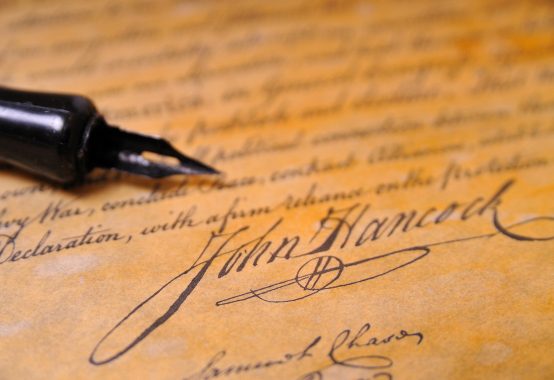

Brad DeLong channels Harry Jaffa in a post about my Declaration item: “Roger B. Taney would agree with Daniel McCarthy–that was, indeed, the point of his Dred Scott decision.” I get off lightly here: when Willmoore Kendall contravened the wisdom of Jaffa, Harry himself said Kendall was practically endorsing Nazism.
Let me decompress a few things. Opposition to slavery is older than the Declaration of Independence, and such opposition can come from a variety of ethical traditions — indeed, any ethical tradition worthy of the name. It’s not the case that absent the Lincoln-Jaffa interpretation of the Declaration, we would not have grounds to oppose human bondage.
But in actual American history, quite apart from the abstract grounds on which one can oppose slavery, didn’t Lincoln’s take on the Declaration lead to emancipation? Only to the extent that it was a boost to Northern morale. Lincoln’s own primary motive in going to war was not to vindicate a philosophy but to preserve the Union, and he was quite clear that he would have compromised on slavery if that might have sufficed to keep the country together. Nor does it seem plausible that abolitionist principle was the main thing driving men to serve in the Army of the Potomac.
The notion that an ideology embedded in the Declaration of Independence was responsible for ending slavery in the United States is simply not true — except, again, to the extent that by manufacturing such an ideology (which Jefferson surely did not implant in the document), Lincoln bolstered the North’s will to prevail. That’s no small thing, but it’s rather less than the Jaffaites insist on.
The benefit to pretending that a high ideal was the motive force in the war is that it makes us feel good about ourselves: Americans can pat themselves on the back knowing that they smashed the evil in their own country and did so in the name of the nation’s original principles. The downside to this myth is that it leads to a lot of delusional behavior in politics and foreign affairs, attributing a saintliness to ourselves that no country possesses.
Understanding that less than idealistic motives can produce even so great a good as ending slavery is an important step toward recognizing the limits of human goodness and perfection. It can also lead to an important recognition of just how much hard work and realism is required to pull off something so important.
Politics does not simply translate pure motives, even the purest, into good results. Motives as mixed as Lincoln’s evidently were can still produce splendid outcomes, while all the good-faith idealism in the world can backfire. Supporting the Iraq War, for example, out of a genuine dedication to the proposition that people everywhere are entitled to self-government would still have been no excuse for facilitating that debacle. Iraqis dead or mutilated as a result of American idealism are no less dead or mutilated than those whose fate was the result of someone’s self-interest.
I recall Christopher Hitchens often using physicist Steven Weinberg’s quote, “With or without religion, good people can behave well and bad people can do evil; but for good people to do evil—that takes religion.” Really that’s true of high ideals of all kinds — otherwise decent people can be bent to support, even carry out, absolutely heinous acts (torture, for example) in the name of any holy cause, liberty or equality as much as God. And a civil religion, unlike traditional ones in the West today, has an army and a constabulary to back up its self-righteousness.
High ideals have a place in politics, but in the post-Reformation world the plurality of ideals is inescapable, which makes “domestic tranquility” a necessary predicate of any higher goal. That’s why replacing the modest deliberative framework of the Constitution with the soaring hopes of Lincoln’s revision of the Declaration — in all their ambiguous extensions and uncompromising absolutes — is an awful idea.