Trump Is Right to Nationalize AI Policy
To compete with China, boost the economy, and avoid woke chatbots, America needs a uniform approach.
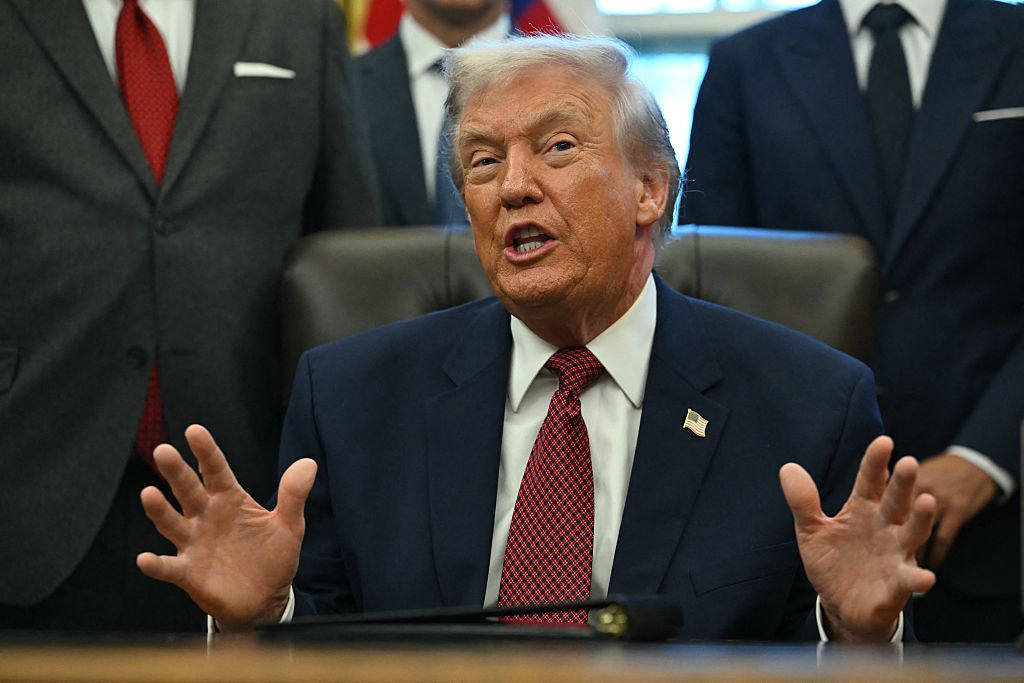
President Donald Trump wants America to follow one uniform policy on AI. That’s in contrast to states that want to impose their own regulations on the technology. Trump is drawing up an executive order and pushing for legislation to ensure the federal government handles the matter.
The president offered the best argument for this policy in a recent Truth Social post:
Investment in AI is helping to make the U.S. Economy the “HOTTEST” in the World, but overregulation by the States is threatening to undermine this Major Growth “Engine.” Some States are even trying to embed DEI ideology into AI models, producing “Woke AI” (Remember Black George Washington?). We MUST have one Federal Standard instead of a patchwork of 50 State Regulatory Regimes. If we don’t, then China will easily catch us in the AI race. Put it in the NDAA, or pass a separate Bill, and nobody will ever be able to compete with America.
Trump’s reasons are pretty solid. We need a national AI policy to support economic growth, prevent blue states from imposing DEI dictates on the technology, and compete with China. Allowing the states to dictate policy will curb growth, make AI woke, and allow China to outpace us on the world stage. Thus, it’s necessary to keep this issue in the hands of the federal government.
Of course, there are some political issues which make sense to leave to the states. But there are others which would be idiotic to have 50 different policies on. For example, trade would be a disaster if Wyoming could establish its own dealings with foreign powers independent of the rest of the country. The same applies for immigration. California and other blue states would love to open their borders to the entire world. It’s necessary for the federal government to step in and establish sensible policies that work for the national interest.
AI is in the same category. We no longer live in the 19th century. It makes no sense in the 21st century for all 50 states to have different policies concerning technology that’s interconnected with the entire globe. Arizona can’t shut out AI developments in China, much less in Colorado, by simply passing a law. A states’ rights approach would force companies to try accommodating 50 different policies, creating a byzantine framework in the process. AI advancement in America would stall as a result. Half of the country’s GDP growth in the first half of 2025 was tied to AI investment. Curtailing the tech would inflict a serious dent on the economy and overall technological development.
There are legitimate concerns with AI, such as concerns over privacy, intellectual property theft, and child safety. But many of the state laws are primarily concerned with DEI matters. California’s AI laws demonstrate this idiotic focus.
The state’s Civil Rights Department implemented new rules this year that would prevent employers from using AI tools to “discriminate” in the hiring process. The law considers resume-screening tools and cognitive-assessment games as possible ways for “algorithmic discrimination” to take place. Mind you, these are computers handling the screening process. Laws such as these insinuate that robots can be racist just by looking at objective data.
It’s similar to how liberals deem fair and unbiased practices “disparate impact” if they result in outcomes unfavorable to minorities. “Unintentional bias” is still racist in the eyes of DEI-crats. The Trump administration has cracked down on “disparate impact” assessments within the federal government, but the thinking behind it persists in AI legislation.
California’s regulations provide a way for DEI apparatchiks to impose their will on companies and mandate “bias audits” of businesses. A bias audit is an evaluation of an AI system to determine if its decisions result in unfavorable outcomes for protected classes. They aim to root out “unintentional bias” according to DEI ideology. While bias audits are technically not required even in the Golden State, the rules effectively force companies to conduct them to maintain their good standing with the California government. “It’s kind of a backdoor way of mandating a bias audit,” David J. Walton, a partner and AI practice chair at Fisher & Phillips LLP, told Bloomberg Law last September.
If California mandates DEI AI policies, the effects will be felt nationwide. Corporations will likely implement the same policy for the rest of their national workforce. California is a huge market, and companies will think it easier just to follow along rather than make an exception.
Rooting out unintentional bias in AI employee discrimination may be just the start. Blue states could also require ChatGPT, Grok, and other chatbots to only offer politically correct answers to users’ questions and image requests. We already experienced the absurdity of AI programs drawing the Founding Fathers and German soldiers as black. Liberals would love to impose their view of history and society on these programs as a matter of law.
And as California goes, so goes America.
State and local AI restrictions would do nothing to stop China’s own advances with the technology. China would continue pushing artificial intelligence to the next level while America fell behind. All the concerns we have with AI would still exist and probably be worse in this situation. You’d still be able to access the latest developments in AI from your computer, regardless of what restrictions your state placed on the tech. China understood the importance of AI to its status as a global power and made it a national policy. Fortunately for them and unfortunately for us, the CCP doesn’t care about rooting out algorithmic discrimination or other DEI nonsense. Its policy centers on the national interest.
Subscribe Today
Get daily emails in your inbox
All these reasons prove why it’s necessary to take this matter out of the states’ hands. A national law would exclude California’s ridiculous demands and safeguard companies from having to implement them. Legislation, as already proposed by Congress, would address the legitimate concerns with AI to protect users’ privacy and our children’s safety. This would make AI better for all and free of the woke demands made by the left.
A national AI policy would help us take on the Chinese challenge and advance American technology. We would ensure that our values, not those of China or California, determine the trajectory of AI development.
We live in a world our Founders couldn’t imagine, but they at least had the foresight to create a system where the national government would solely determine matters of urgent national significance. There are many matters best left to states and towns, but AI policy is not one of them.