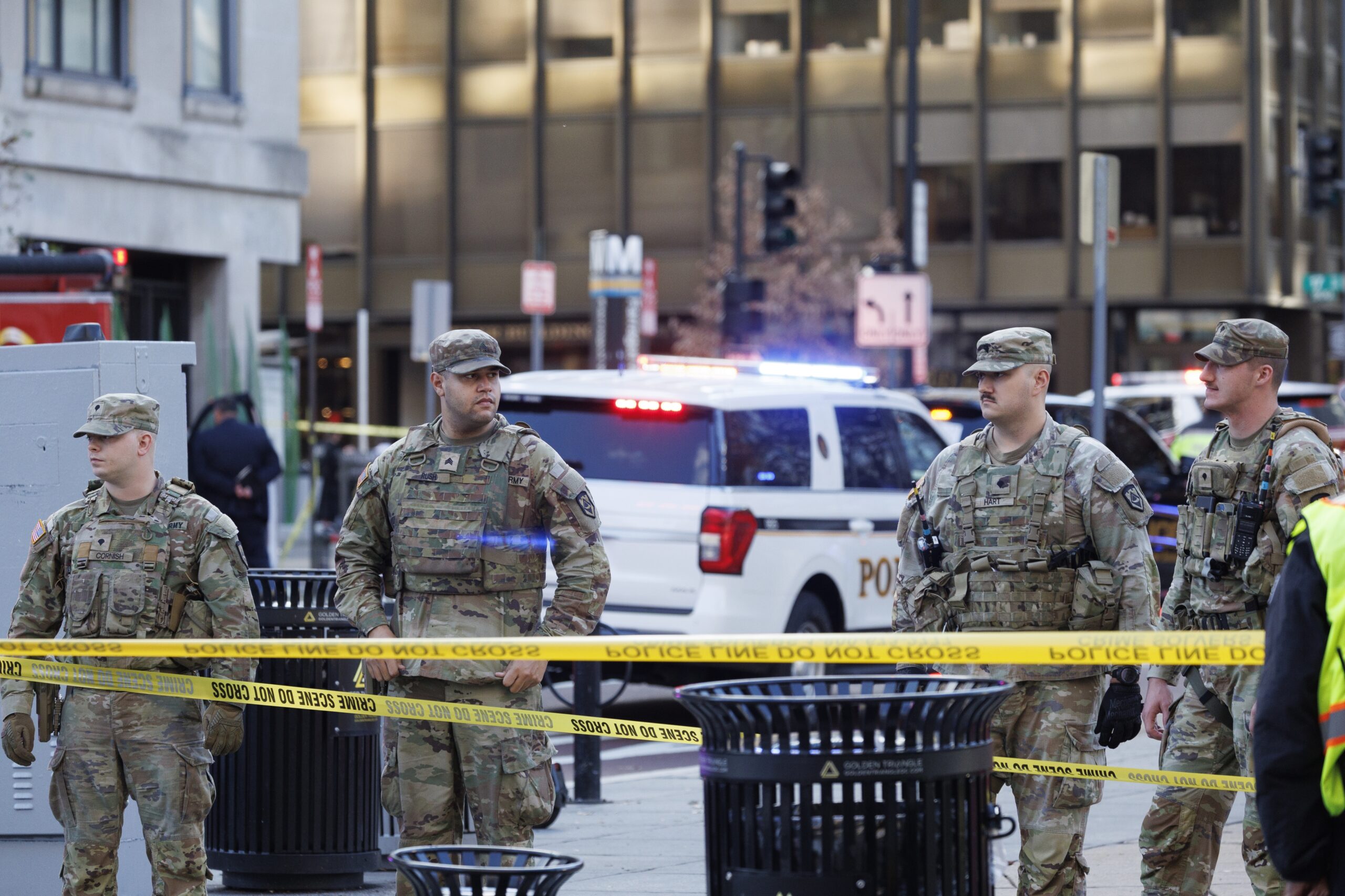

Less than a week before the fatal ambush of two National Guard soldiers in Washington, DC, some friends and I ran into a local politician who asked our views on the deployment.
We reported that certain areas of the city seemed safer since the National Guardsmen arrived, that the local crime statistics generally supported this impression, and that the soldiers were professional and restrained in their dealings with the locals. The politician didn’t contest much of this, but noted that residents didn’t like the National Guard presence—my friends and I commute into the city from the nearby suburbs—and the data showed some area businesses were being harmed as a result.
A lot of local attitudes about the National Guard deployment have more to do with people’s feelings about President Donald Trump than their views about crime in the nation’s capital. More than 90 percent of the city voted against Trump, who received just 6.5 percent of the ballots cast there last year. The federal district was one of the few places where Trump didn’t even win the Republican primary.
Many DC residents, like the locals in other big blue cities throughout the country, view the National Guardsmen as an occupying force rather than as critical support for local law enforcement in a high-crime jurisdiction.
It is understandable why people would object in principle to the military taking on a domestic law-enforcement role, though DC’s constitutional status raises fewer legal questions than in other cities, and posse comitatus doesn’t really seem to be the main driver of the controversy.
It wasn’t a local insurrection against this supposed DC occupation that resulted in the murder of one young soldier and the serious wounding of another just blocks from the White House. The suspect was instead an Afghan national who had worked with the U.S. government, including the CIA, during our 20-year, post-9/11 war, allegedly driving all the way from Washington state to commit the crime. That war began when the suspect was a child.
It was also a far cry from the prediction made by the Democratic senator from Michigan, Elissa Slotkin, who narrowly won her seat at the same time Trump was carrying the state in the presidential election. “It makes me incredibly nervous,” Slotkin said in an interview with ABC News, “that we’re about to see people in law enforcement, people in [the] uniformed military, get nervous, get stressed, shoot at American civilians.”
There are huge differences of opinion among American citizens who have lived in this country for their entire lives, which are in some cases proving radicalizing in a time of intense political and cultural polarization. We augment this by importing the diversity of opinion that exists throughout the entire world.
In some cases, this migration is happening in the context of foreign wars during which people are displaced and lives are ruined. While many of these people worked closely with Americans and were indispensable allies during these conflicts, such experiences in many cases must be more radicalizing than anything that can realistically happen to most people domestically.
The vetting of people coming in from other countries could no doubt be improved. But it will never be perfect, and can occur under numbers or circumstances that will on occasion defeat even a thorough and judicious vetting process.
Subscribe Today
Get daily emails in your inbox
Under these conditions, it is actually remarkable—and quite fortunate for us—that things are not much worse.
Any policy that could possibly be implemented to address the situation, ranging from immigration controls to foreign-policy restraint to local crime crackdowns, will surely elicit a fierce political pushback that will make some of the simmering tensions noticeably worse.
Most of the time, the consequences will be far less than the tragic, violent death of a brave young woman serving her deeply divided country. Yet even during a period dedicated to national thanksgiving, we are not always so fortunate.