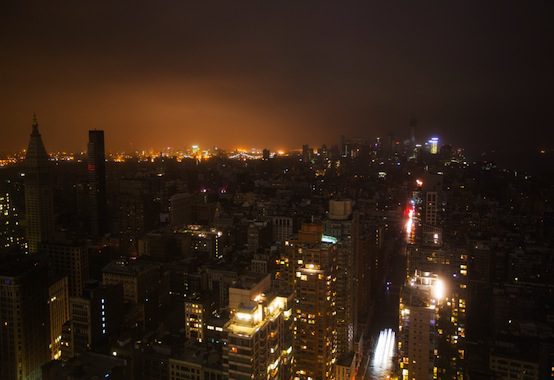
I had an easier time than many New Yorkers last night. I live in Chelsea, which is blacked out and partly under water. But I’m weathering the storm on the Upper East Side, where damage is minimal. Uptown looks no worse than after a hard rain. The images from downtown, as well as parts of Brooklyn and much of Staten Island, are apocalyptic.
Because I was lucky enough to be secure in life and property last night, I had the luxury of thinking philosophically. I thought mostly of Spinoza, who instructed his readers: “I would warn you that I do not attribute to nature either beauty or deformity, order or confusion. Only in relation to our imagination can things be called beautiful or ugly, well-ordered or confused.”
According to Spinoza, the evaluation of natural events is folly. Because nothing happens for a purpose, all that we can do is attempt to understand events’ causes–and to guard against their consequences. As they survey the destruction, whether in person, on the Internet, or on television, some readers may find this thought monstrous. This morning, I find it oddly comforting.


Spinoza is a bad guide. One has to avoid the error of retreating into a falsehood in order to avoid its opposite falsehood.
Of course there is beauty and deformity in nature that is on the side of the object and not merely a tint given it by the subject; otherwise we’d not have common values and language for such perceptions. We all spontaneously recognize monsters and the ill effects of accident and disease; this proves (if we needed proof) that the positive opposite of which deformity is the privation also exists.
And of course there is purpose: the very notions of beauty and ugliness or deformity imply purpose. Note, though: this does not immediately and eo ipso imply a purposeful “personal God” — this is the error of uninstructed Christians who fall into the anthropological error. But it does, immediately, imply purpose in the things that we are considering — an acorn has a purpose that no one can deny; and one can reason from this to the utter foolishness of asserting chance or randomness as the first agent of all things — such an assertion is quite literally unthinkable since it contains its own contradiction: chance and the random imply the existence of the purposeful. You can’t get meaning out of non-meaning!
Back to your crepuscular ruminations: Of course there is chance, randomness, the meaningless, in nature: this is because nature contains potentiality: natural things are not “all given at once” and are subject to change and becoming; whence the necessity of the possibility of going awry. So you are right to think that Sandy’s damages are not the result of someone “out to get us.” Shit does happen. But it happens so to speak in the interstices, in the cracks: reality itself is meaningful, otherwise it could not — quite literally, with ontological necessity — not exist.