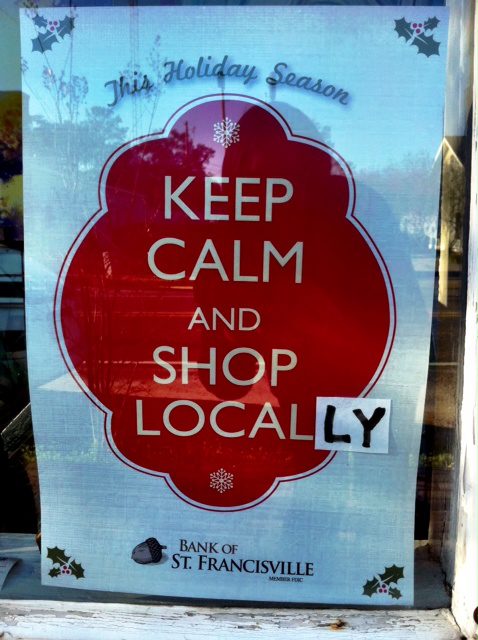
Grammar Geeks At Christmas
15 Responses to Grammar Geeks At Christmas
-
What in the world is grammar?
-
Hi Rod. I hate to ruin your grammar fun, but it’s actually fine grammatically to end a sentence with “put up with.” Here’s the reason: while it’s generally wrong to end a sentence (actually a clause) a preposition, “to put up with” is actually treated as a single compound verb. (Similar compound verbs that end with prepositions are “to catch up,” to “match up,” to “go out” (in the sense of dating), etc.
So since ending a sentence with a verb is fine, ending a sentence with a compound verb — even one that includes an ending proposition — is also fine and good grammar.
So since you can say, “Bad grammar is something man cannot stomach” (using stomach as a verb), it’s also correct to say “Bad grammar is something a man cannot put up with” (using “to put up with” as a single compound verb).
English majors unite forever! Merry Christmas.
[Note from Rod: Thanks, Isaac, but I was joking about grammar Pharisaism; Churchill supposedly used that "up with which I will not put" formulation to twit one of his speechwriters, or somesuch person, who was standing senselessly on a grammar rule. -- RD]
-
Re: Adjectives-as-adverbs is a mistake that particularly peeves me
It’s nothing but good old Germanic grammar. To this day in German and Dutch any adjective may be used as an adverb without any modification of form. It was those Frenchies who came over with Duke William the Bastard that imposed the need to add something to an adjective to make it an adverb.
-
You have a Bank of St Francisville?
And was the manager once rescued from a watery death by a passing apprentice angel?
-
This professional grammar nerd loves it
-
as a grammatically impaired person, I will confess, I need improvement, and the tolerance for such impairment is vastly appreciated.
-
Never mind the grammar. I saw a similar sentiment posted by the cash register at a small local jewelry store (semi-precious and interesting foreign crafts) which said “If you really want to Occupy Wall Street, this Christmas, spend your money at a small locally owned business.” Which happens to be what I was doing when I read the sign.
But I do recall some labor negotiations in Sacramento County, California, circa 1975, when a representative of in-home care workers called the management negotiator an incompetent fool, and the man responded literally, “That is a piece of impertinence up with which we will not put.”
-
Thank you, Rod.
Here’s my favorite sign, posted on the doors of retail store restrooms throughout the Midwest: “No unpaid merchandise in restrooms.”
Who pays merchandise?
Merry Christmas.
-
I’m a grammar Nazi myself (I teach Latin, for crying out loud), but I think an argument can be made that “Shop Local” is fine in this context. Adjectives and adverbs can convey slightly different nuances.
After all, it’s correct to say “I feel bad” when you are not feeling well. It is *not* the same thing as saying “I feel badly”. If you say “I feel badly”, it means that your sensory apparatus is not working properly, i.e., your sense of perception is working badly. (“I feel well” is confusing, because “well” can be both the adverb corresponding to the adjective “good”, and an adjective in its own right meaning something like “healthy”.)
So, “shop locally” can mean “shop in a local manner” or “shop in the local vicinity”, which is certainly part of what the writer is trying to convey. Whereas “shop local” can mean “purchase things that are locally produced” or “purchase things in a way that supports local business”.
This is grammatically similar to the expression “buy American”, which means “buy merchandise that was made in America”.
After all, not even the strictest of grammar Nazis would “correct” “buy American” to “buy Americanly” — which, if one insists that only adverbs, not adjectives, are correct in this situation, would be the correct expression. But what would “buy Americanly” mean? “Buy in the American manner”? I suppose “buying in the American manner” would be buying on credit.
But I do admit to feeling a frisson of satisfaction when I noticed that the sign on the express checkout at the local supermarket had been changed from “10 items or less” to “10 items or fewer”.
-
Language Log, naturally, has something to say:
http://itre.cis.upenn.edu/~myl/languagelog/archives/005123.html -
Sign of a traffic board in downtown Baltimore today:
DRIVE SOBER – OR YOU’LL BE LOCKED UP
Nope, not “soberly”.
-
If to shop equals to be, “local” in this case could be a predicate adjective. As tied up as localism has become with identity, it’s plausible!
-
Rod,
When someone asks “How are you,” do you respond with “I am well” or “I am good”?
I know a lot of people who make a big show of saying “well.” This strikes me as incorrect. If someone asks “How is your new house,” I don’t say, “It’s warmly and cozily, I just wish it was not so expensively.”
Predicate adjective.
Just curious.
-
SamM: As I remarked in my previous post on this thread, the problem with “well” is that it is both an adverb (corresponding to the adjective “good”) as well as an adjective in its own right, meaning “sound, healthy”. Being “well” is the opposite of being “unwell”, i.e., not healthy”.
Saying “I am good” is not incorrect, it just doesn’t mean the same thing as “I am well”. “I am good” is the opposite of “I am bad”. Though, of course, most people who say “I am good” really mean “I am well”; again, because “well” is both an adjective and an adverb, this can lead to ambiguity and confusion.
I think you are correct that “local” in “shop local” is a predicate adjective, which I sort of what I was trying to say in my previous post, though the term escaped me. Thank you!
JonF’s example of “drive sober” is another illustration of this. When we say “drive sober!”, we are essentially saying, “be sober when you drive!” or “drive in a sober condition!”. “sober” here is a predicate adjective modifying the implied “you” that is the subject of the imperative verb “drive”.
To say “drive soberly” is not the same thing. “driving soberly” would mean “drive in a sober manner”. I think there are a lot of people can drive soberly — in a sober manner — even when they are not quite sober, if they are careful.


“…bad grammar is something up with which a man cannot put.”
Am I crazy, or is this a Phineas and Ferb reference?
Adjectives-as-adverbs is a mistake that particularly peeves me…which is unfortunate, since it seems to be something people around here do a lot.
[Note from Rod: Nah, it's a reference to a Churchill anecdote, which may be apocryphal. -- RD]