
Wrong About Morsi
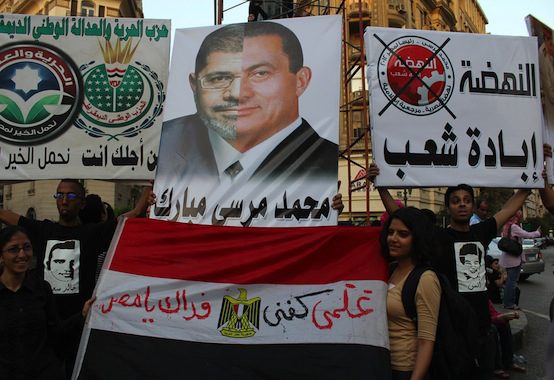
I have long congratulated myself for sound political judgement, so it’s an unpleasant shock to be found very wrong, very quickly. A few months ago, I was optimistic about Egypt’s newly elected Muslim Brotherhood President, Mohammed Morsi. I was wrong to be.
I don’t know how the current clash between the diverse opponents of Morsi’s bid for authoritarian control will end up. But one often sees what one wishes to, and I wanted to see that some sort of Islamic democracy, perhaps something like the Turkish model, was a viable path for Egypt. Morsi gave an impression of sharing that vision. But seemingly pulled by some inexorable cultural force (Islamic, Pharonic, or simply human), he has bid to give himself authoritarian powers, while trying to silence the opposition rather than compromise with it.
Democracy is hardly a common form of human governance: in Europe, some form of fascism was freely chosen by half the continent in the ’20s and ’30s. In any case, if you know Egypt at all and were thrilled by the largely peaceful 2011 revolution it’s hard to not despair as the country seemingly slides towards civil war and/or dictatorship. I have no brief for those (comprising the vast majority of American media) whose only concern seems to be whether Egypt will remain compliant towards the Israeli blockade of Gaza and occupation of the West Bank. But an Egypt which deprives itself of its most modern, educated, and liberal sectors — as Morsi seems intent on doing, can hardly advance the country or the region.
In these tense days, I’m reading the intrepid Max Blumenthal, who is now in the center of things in Cairo, and the contributors to The Arabist, a sophisticated blog produced by knowledgeable, Cairo based, liberals — liberals in the European sense. In writing that sentence I’m reminded of Fritz Stern, historian of modern Germany and a college and graduate school mentor: in Germany, liberalism was the one cause that always lost. Not just there, it would seem.


Comments